



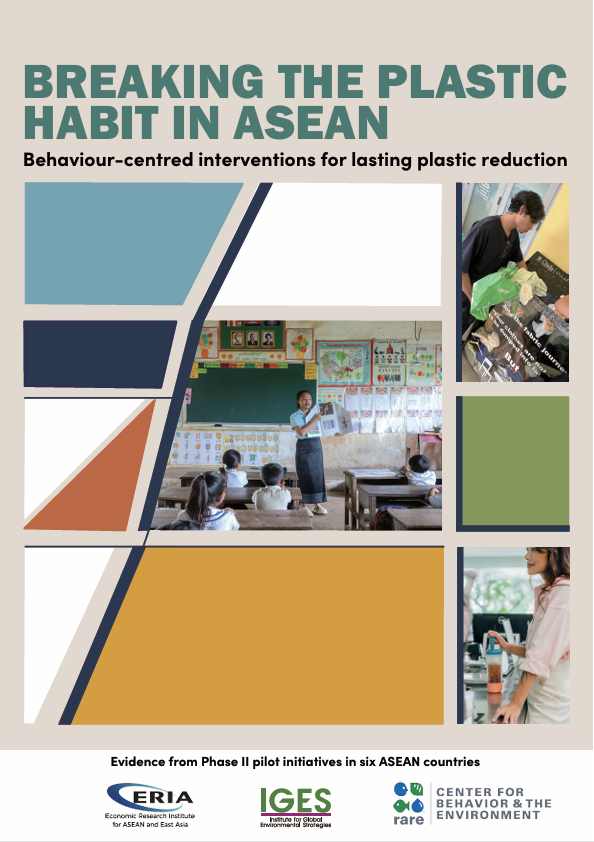
Plastic pollution is a growing challenge in Southeast Asia, where rapid urbanisation and rising consumption are driving sharp increases in plastic waste. While traditional regulations such as plastic bans and information campaigns are important, they often fail to shift deeply ingrained consumption and waste management habits on their own. This new report demonstrates how applying behavioural science to the challenge of plastic pollution can effectively bridge the “intention–action gap” among individuals, institutions, and businesses.
Phase II of Breaking the Plastic Habit in ASEAN explored how insights from the behavioural sciences can help close this gap through the application of a psychosocial theory of change and the use of behaviour-centred design processes. Through six pilot interventions in Cambodia, Indonesia, Lao PDR, the Philippines, Thailand, and Viet Nam, the project innovated homegrown behaviour-centred approaches to bring about a lasting reduction in plastic consumption.
The pilots achieved measurable reductions in single-use plastic consumption and improvements in waste management among individuals, institutions, and businesses. The findings show that lasting change is most likely when sustainable choices are easy, socially reinforced, and connected to local values. Integrating behavioural insights into policy design can therefore strengthen ASEAN’s efforts to tackle plastic pollution.
Access the Japanese version of the report here.


Plastic pollution is a growing challenge in Southeast Asia, where rapid urbanisation and rising consumption are driving sharp increases in plastic waste. While traditional regulations such as plastic bans and information campaigns are important, they often fail to shift deeply ingrained consumption and waste management habits on their own. This new report demonstrates how applying behavioural science to the challenge of plastic pollution can effectively bridge the “intention–action gap” among individuals, institutions, and businesses.
Phase II of Breaking the Plastic Habit in ASEAN explored how insights from the behavioural sciences can help close this gap through the application of a psychosocial theory of change and the use of behaviour-centred design processes. Through six pilot interventions in Cambodia, Indonesia, Lao PDR, the Philippines, Thailand, and Viet Nam, the project innovated homegrown behaviour-centred approaches to bring about a lasting reduction in plastic consumption.
The pilots achieved measurable reductions in single-use plastic consumption and improvements in waste management among individuals, institutions, and businesses. The findings show that lasting change is most likely when sustainable choices are easy, socially reinforced, and connected to local values. Integrating behavioural insights into policy design can therefore strengthen ASEAN’s efforts to tackle plastic pollution.
Access the Japanese version of the report here.
Dwayne Appleby, Alice Marie Yamabe-Ledoux, Atsushi Watabe
Economic Research Institute for ASEAN and East Asia (ERIA), Institute for Global Environmental Strategies (IGES), and Rare Center for Behavior & the Environment