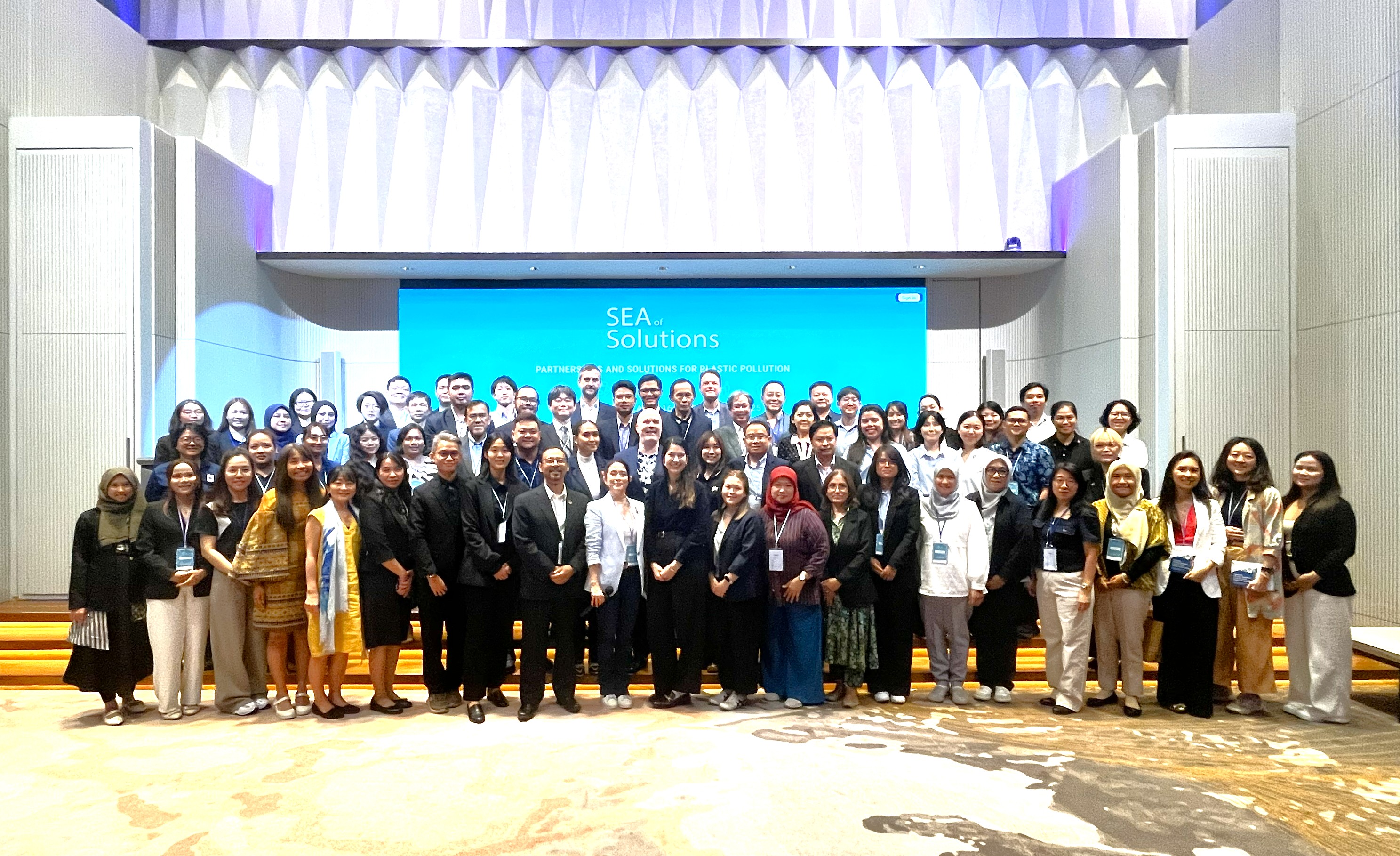




Bangkok, 16–17 December 2025: The 6th SEA of Solutions was held under the theme ‘Partnerships and Solutions for Plastic Pollution’. Organised by the Coordinating Body of the Seas of East Asia (COBSEA) and the United Nations Environment Programme (UNEP), the forum brought together government representatives, experts, private sector stakeholders, and youth to address plastic pollution and marine litter.
The programme comprised eight thematic sessions and four plenaries, including dedicated discussions on knowledge sharing and behaviour change. Experts from ERIA’s Regional Knowledge Centre for Marine Plastic Debris participated, with Mr Reo Kawamura serving as a panellist in the knowledge-sharing session and Ms Ayako Mizuno moderating the behaviour change session. These contributions informed broader discussion on challenges and approaches to addressing plastic pollution.
Given the critical role of knowledge and data in enabling regional–global integration to combat marine plastic pollution, several platforms have been established to support knowledge sharing and collaboration. Four key platforms highlighted during the session were:
UNEP’s Global Plastics Hub, a global collaborative platform that functions as a knowledge hub, data hub, and community hub to support efforts to end plastic pollution.
CSIRO’s Indo-Pacific Plastics Innovation Network (IPPIN), which serves as a cross-sector and cross-country learning platform, with projects implemented in Indonesia, Thailand, and Viet Nam.
ERIA’s Regional Knowledge Centre, which provides accessible and policy-relevant information on marine plastic issues and plastic countermeasures across the ASEAN+3 region.
UNEP’s Global Action Partnership for Extended Producer Responsibility (EPR), which offers an extensive library of EPR-related resources and practical tools to support the development and implementation of EPR systems.
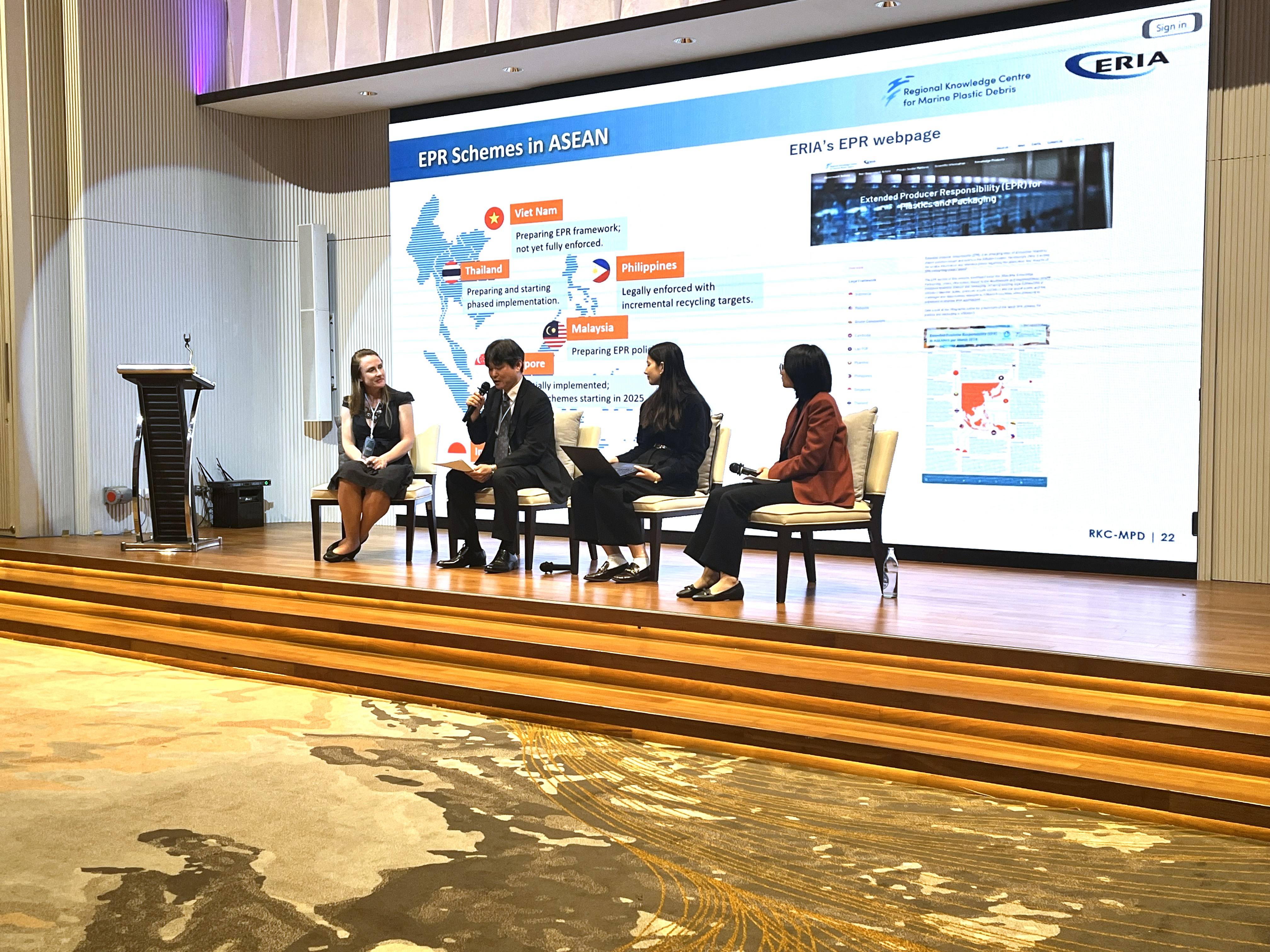
Speakers discussed how knowledge systems can be strengthened to better address plastic pollution. Ms Amelia Fyfield (CSIRO) highlighted the need to explore diverse business models, including partnerships with waste banks. Building on this, Ms Ran Xie (UNEP) emphasised the importance of quality assurance mechanisms to ensure that shared information remains clear, credible, and relevant. Ms Ana Kumarasamy (UNEP) then noted that UNEP has made guidelines available to support youth-focused knowledge dissemination. Complementing these points, Mr Kawamura underscored the importance of collaboration across platforms, stressing that no single organisation can address all dimensions of the issue and that stronger alignment is needed to avoid duplication.
This session examined the critical role of behaviour change in enabling effective and scalable reuse systems. Speakers emphasised that reuse systems will not scale if they are difficult to adopt, unaffordable, or lacking consumer trust, and that fragmented systems further limit adoption.
Key barriers included:
Reuse systems being perceived as less convenient and more expensive than single-use options, with distance, complexity, and entrenched habits as major obstacles.
Hygiene concerns due to limited transparency in cleaning processes, a lack of standardised protocols, and unclear communication.
Limited centralised infrastructure for washing, collection, and logistics.
Fragmented actors and weak policy support, which slow integration and scaling.
Proposed solutions included:
Designing reuse systems that are affordable, convenient, and familiar.
Investing in centralised and institutionalised reuse infrastructure – covering washing, collection, and logistics – with standardised procedures, or exploring integration with EPR systems.
Embedding reuse into policies and strengthening government collaboration, cross-sector partnerships, and access to finance and incentives.
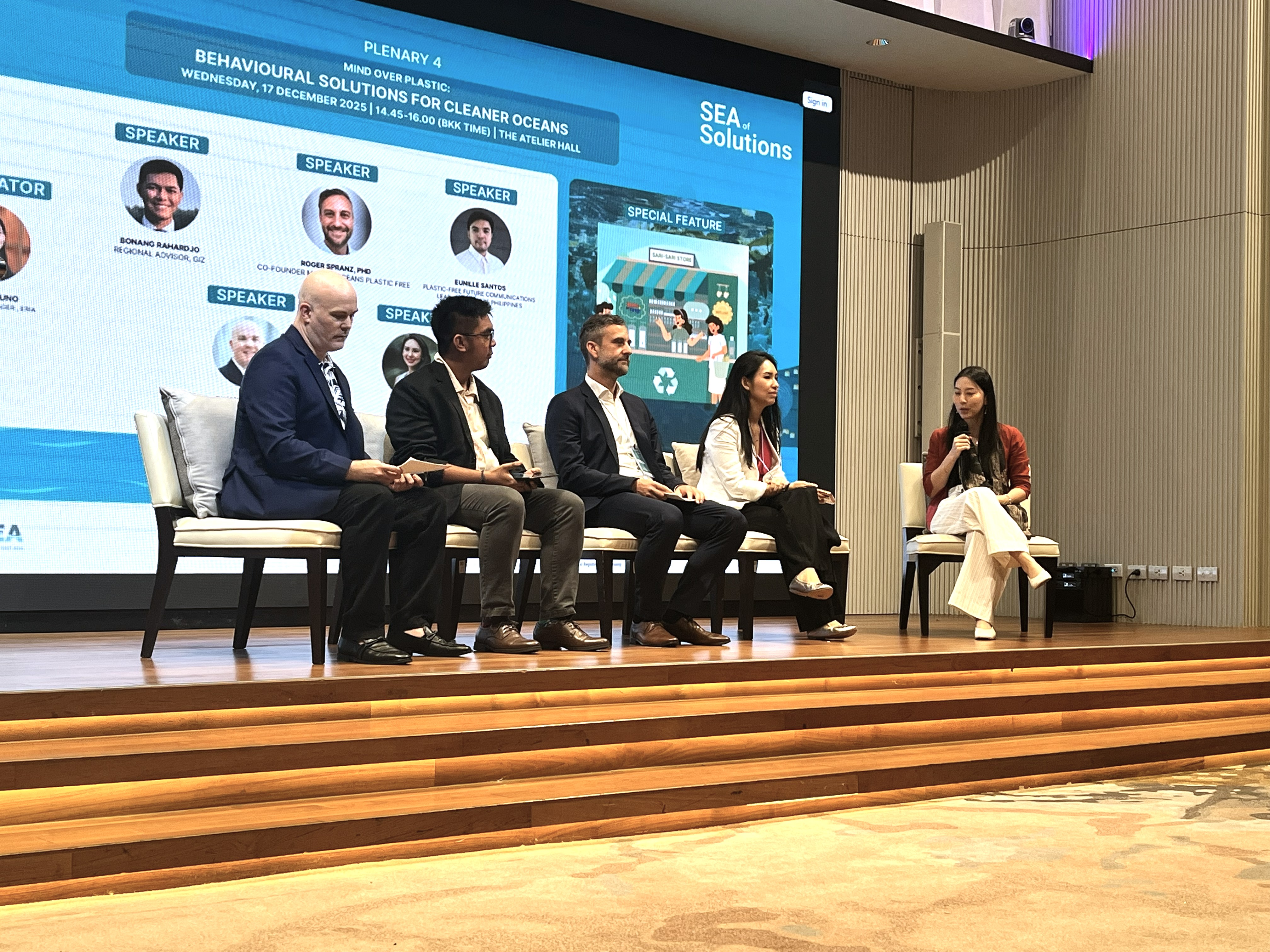
The session ultimately underscored that sustainable change requires attention to both behaviour and broader systemic conditions. For small-scale pilots to succeed, reuse systems must be low-cost, convenient, and trustworthy, as well as offer desirable options for users. Success also depends on enabling policies, shared infrastructure, and social support that make behaviour change practical and sustainable. By addressing these factors, reuse systems can be expanded, facilitating behavioural shifts and longer-term reductions in single-use plastic.

Research Associate


Bangkok, 16–17 December 2025: The 6th SEA of Solutions was held under the theme ‘Partnerships and Solutions for Plastic Pollution’. Organised by the Coordinating Body of the Seas of East Asia (COBSEA) and the United Nations Environment Programme (UNEP), the forum brought together government representatives, experts, private sector stakeholders, and youth to address plastic pollution and marine litter.
The programme comprised eight thematic sessions and four plenaries, including dedicated discussions on knowledge sharing and behaviour change. Experts from ERIA’s Regional Knowledge Centre for Marine Plastic Debris participated, with Mr Reo Kawamura serving as a panellist in the knowledge-sharing session and Ms Ayako Mizuno moderating the behaviour change session. These contributions informed broader discussion on challenges and approaches to addressing plastic pollution.
Given the critical role of knowledge and data in enabling regional–global integration to combat marine plastic pollution, several platforms have been established to support knowledge sharing and collaboration. Four key platforms highlighted during the session were:
UNEP’s Global Plastics Hub, a global collaborative platform that functions as a knowledge hub, data hub, and community hub to support efforts to end plastic pollution.
CSIRO’s Indo-Pacific Plastics Innovation Network (IPPIN), which serves as a cross-sector and cross-country learning platform, with projects implemented in Indonesia, Thailand, and Viet Nam.
ERIA’s Regional Knowledge Centre, which provides accessible and policy-relevant information on marine plastic issues and plastic countermeasures across the ASEAN+3 region.
UNEP’s Global Action Partnership for Extended Producer Responsibility (EPR), which offers an extensive library of EPR-related resources and practical tools to support the development and implementation of EPR systems.
Speakers discussed how knowledge systems can be strengthened to better address plastic pollution. Ms Amelia Fyfield (CSIRO) highlighted the need to explore diverse business models, including partnerships with waste banks. Building on this, Ms Ran Xie (UNEP) emphasised the importance of quality assurance mechanisms to ensure that shared information remains clear, credible, and relevant. Ms Ana Kumarasamy (UNEP) then noted that UNEP has made guidelines available to support youth-focused knowledge dissemination. Complementing these points, Mr Kawamura underscored the importance of collaboration across platforms, stressing that no single organisation can address all dimensions of the issue and that stronger alignment is needed to avoid duplication.
This session examined the critical role of behaviour change in enabling effective and scalable reuse systems. Speakers emphasised that reuse systems will not scale if they are difficult to adopt, unaffordable, or lacking consumer trust, and that fragmented systems further limit adoption.
Key barriers included:
Reuse systems being perceived as less convenient and more expensive than single-use options, with distance, complexity, and entrenched habits as major obstacles.
Hygiene concerns due to limited transparency in cleaning processes, a lack of standardised protocols, and unclear communication.
Limited centralised infrastructure for washing, collection, and logistics.
Fragmented actors and weak policy support, which slow integration and scaling.
Proposed solutions included:
Designing reuse systems that are affordable, convenient, and familiar.
Investing in centralised and institutionalised reuse infrastructure – covering washing, collection, and logistics – with standardised procedures, or exploring integration with EPR systems.
Embedding reuse into policies and strengthening government collaboration, cross-sector partnerships, and access to finance and incentives.
The session ultimately underscored that sustainable change requires attention to both behaviour and broader systemic conditions. For small-scale pilots to succeed, reuse systems must be low-cost, convenient, and trustworthy, as well as offer desirable options for users. Success also depends on enabling policies, shared infrastructure, and social support that make behaviour change practical and sustainable. By addressing these factors, reuse systems can be expanded, facilitating behavioural shifts and longer-term reductions in single-use plastic.
Research Associate