




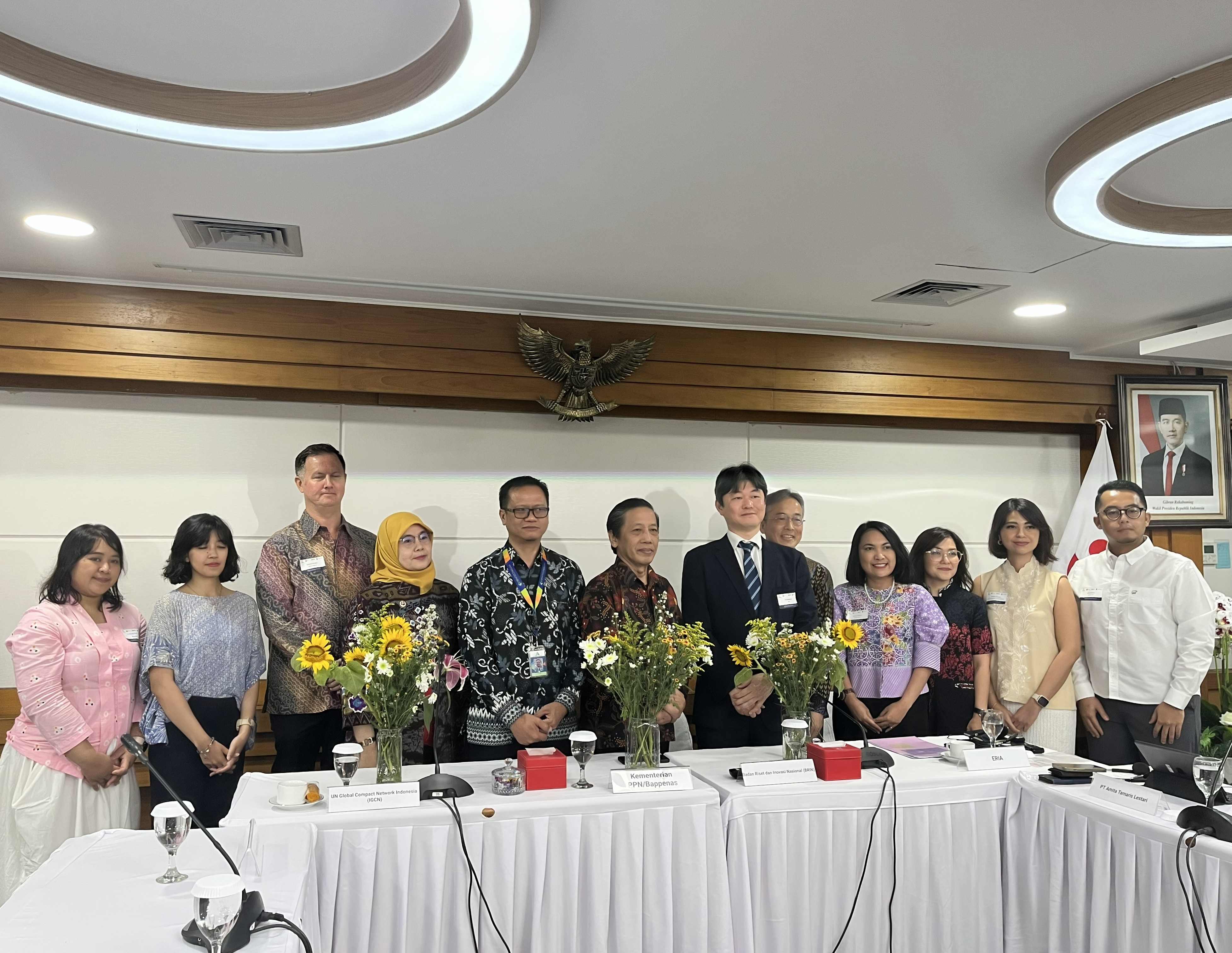
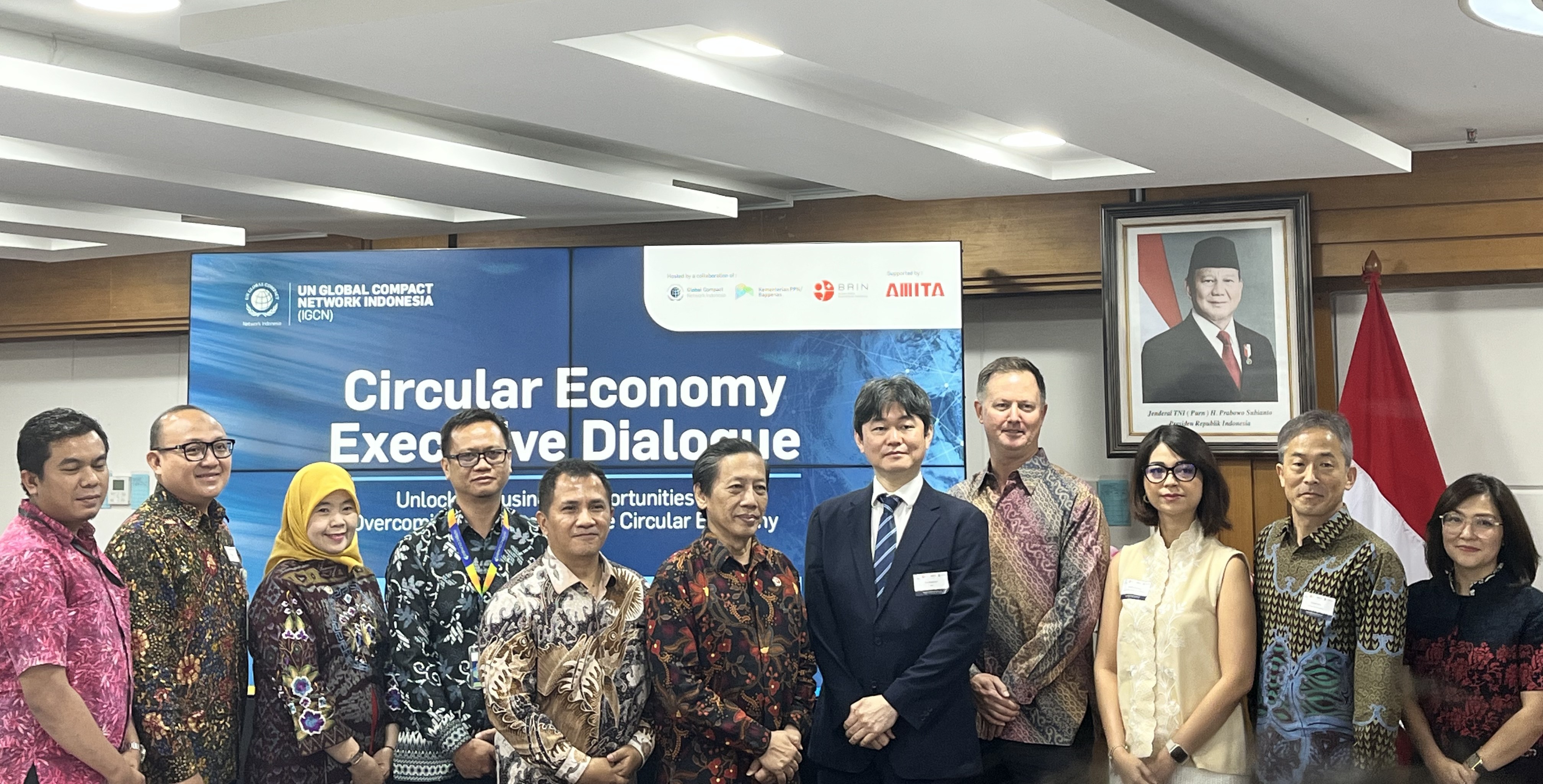
Jakarta, 12 February 2026: The Circular Economy Executive Dialogue convened as a high-level forum for dialogue, knowledge-sharing, and collaboration aimed at accelerating Indonesia’s circular transformation. Hosted through a collaboration between the UN Global Compact Network Indonesia (IGCN) and Indonesia’s Ministry of National Development Planning (Bappenas), the meeting facilitated cross-sectoral dialogue amongst businesses, policymakers, financiers, and ecosystem enablers.
Emphasising the strategic importance of the circular economy, Mr R. Hendrian, Deputy for Research and Innovation Utilisation at the National Research and Innovation Agency, underscored that the circular economy is not merely a policy agenda but a concrete action toward achieving Indonesia Emas 2045 – the country’s long-term national development vision for 2045 – serving both environmental and national economic priorities. Echoing this perspective, Mr Leonardo A. A. Teguh Sambodo, Deputy Minister at Bappenas, highlighted the circular economy’s potential to strengthen industrial competitiveness, create jobs, and safeguard the environment, making it a key driver of sustainable and inclusive growth.
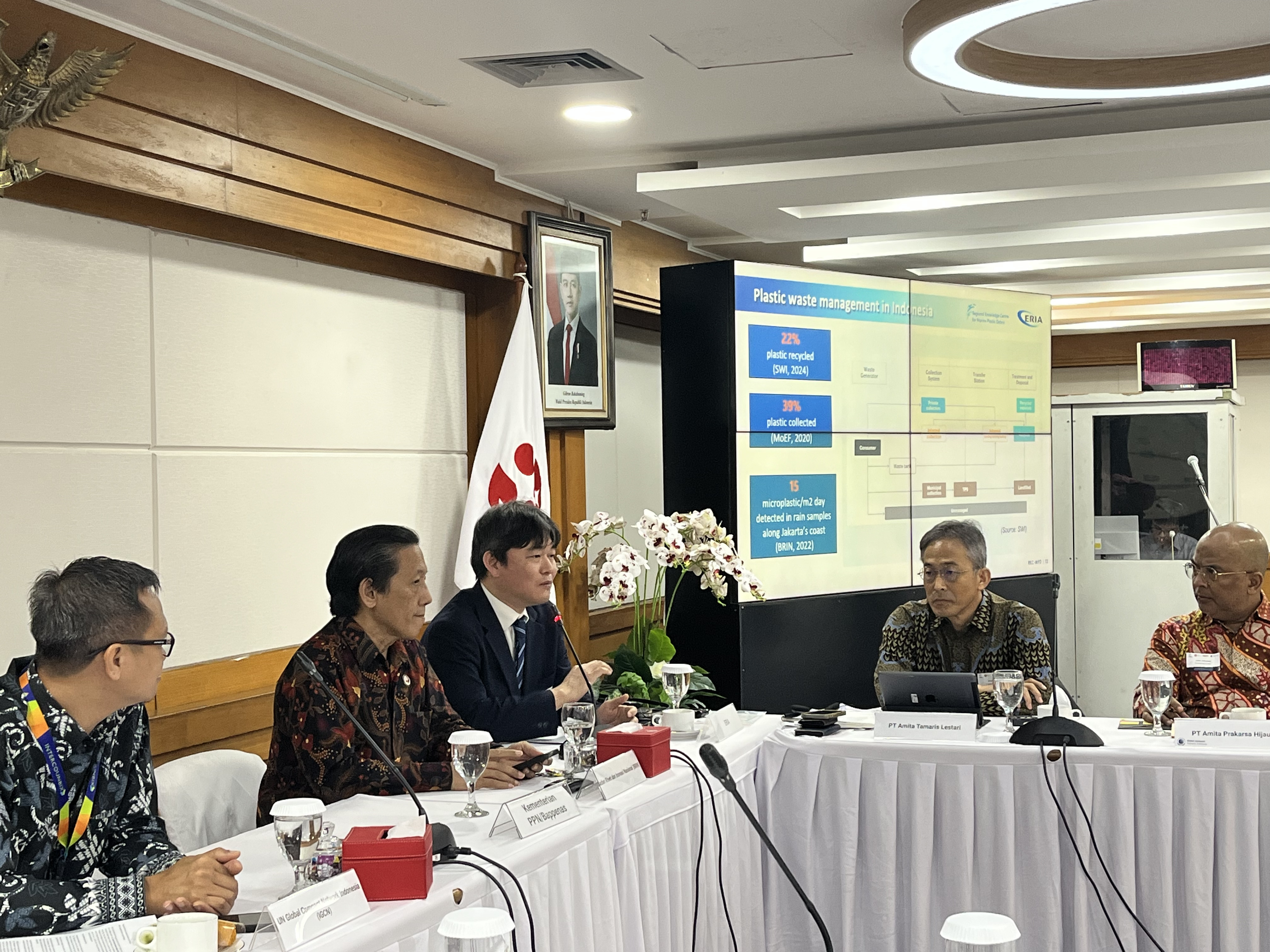
Mr Reo Kawamura, Director of the Environmental Policy and Regional Knowledge Centre for Marine Plastic Debris at ERIA, cited data from the 2025 OECD Regional Plastics Outlook for Southeast and East Asia, stating that ASEAN is a global hotspot for plastic pollution, accounting for one-third of global plastic leakage. The associated risks to ecosystem and human health underscore the urgent need for a paradigm shift from a linear to a circular approach across the entire value chain. In this regard, Indonesia has demonstrated leadership in addressing plastic pollution by organising the ASEAN Conference on Combatting Plastic Pollution (ACCPP) 2023 in Jakarta, which contributed to the issuance of the ASEAN Declaration on Plastic Circularity in 2024. Several companies in Indonesia have also shown promising recycling practices. For example, Coca-Cola Europacific Partners Indonesia has developed a post-consumer bottle collection network and initiated the production of new bottles using recycled materials, while Rekosistem, a local startup, provides app-based waste collection services to facilitate and encourage waste segregation and recycling.
The meeting also included the launch of the IGCN Circular Economy Working Group, which will serve as a platform for companies and partners to collaborate on circular innovation, policy dialogue, and measurable sustainability actions. This initiative is expected to support scientific research, strengthen governance alignment, and foster constructive exchanges of ideas amongst stakeholders.
Although the transition toward a circular economy continues to face significant challenges – such as regulatory uncertainty, limited feedstock availability, high investment costs with uncertain returns, and low public demand for recycled materials – these constraints also highlight the areas requiring strategic intervention. Stronger contributions are therefore needed from both upstream and downstream actors, alongside greater inclusion of small and medium-sized industries, and enhanced transparency across the entire value chain. Ultimately, the success of this dialogue will depend on its ability to move beyond discussion and translate into concrete action. After all, the true value of the circular economy lies not in the conversations it inspires, but in the measurable impact it delivers.

Research Associate


Jakarta, 12 February 2026: The Circular Economy Executive Dialogue convened as a high-level forum for dialogue, knowledge-sharing, and collaboration aimed at accelerating Indonesia’s circular transformation. Hosted through a collaboration between the UN Global Compact Network Indonesia (IGCN) and Indonesia’s Ministry of National Development Planning (Bappenas), the meeting facilitated cross-sectoral dialogue amongst businesses, policymakers, financiers, and ecosystem enablers.
Emphasising the strategic importance of the circular economy, Mr R. Hendrian, Deputy for Research and Innovation Utilisation at the National Research and Innovation Agency, underscored that the circular economy is not merely a policy agenda but a concrete action toward achieving Indonesia Emas 2045 – the country’s long-term national development vision for 2045 – serving both environmental and national economic priorities. Echoing this perspective, Mr Leonardo A. A. Teguh Sambodo, Deputy Minister at Bappenas, highlighted the circular economy’s potential to strengthen industrial competitiveness, create jobs, and safeguard the environment, making it a key driver of sustainable and inclusive growth.
Mr Reo Kawamura, Director of the Environmental Policy and Regional Knowledge Centre for Marine Plastic Debris at ERIA, cited data from the 2025 OECD Regional Plastics Outlook for Southeast and East Asia, stating that ASEAN is a global hotspot for plastic pollution, accounting for one-third of global plastic leakage. The associated risks to ecosystem and human health underscore the urgent need for a paradigm shift from a linear to a circular approach across the entire value chain. In this regard, Indonesia has demonstrated leadership in addressing plastic pollution by organising the ASEAN Conference on Combatting Plastic Pollution (ACCPP) 2023 in Jakarta, which contributed to the issuance of the ASEAN Declaration on Plastic Circularity in 2024. Several companies in Indonesia have also shown promising recycling practices. For example, Coca-Cola Europacific Partners Indonesia has developed a post-consumer bottle collection network and initiated the production of new bottles using recycled materials, while Rekosistem, a local startup, provides app-based waste collection services to facilitate and encourage waste segregation and recycling.
The meeting also included the launch of the IGCN Circular Economy Working Group, which will serve as a platform for companies and partners to collaborate on circular innovation, policy dialogue, and measurable sustainability actions. This initiative is expected to support scientific research, strengthen governance alignment, and foster constructive exchanges of ideas amongst stakeholders.
Although the transition toward a circular economy continues to face significant challenges – such as regulatory uncertainty, limited feedstock availability, high investment costs with uncertain returns, and low public demand for recycled materials – these constraints also highlight the areas requiring strategic intervention. Stronger contributions are therefore needed from both upstream and downstream actors, alongside greater inclusion of small and medium-sized industries, and enhanced transparency across the entire value chain. Ultimately, the success of this dialogue will depend on its ability to move beyond discussion and translate into concrete action. After all, the true value of the circular economy lies not in the conversations it inspires, but in the measurable impact it delivers.
Research Associate



 Workshop Empowers Youth to Advance Environmental Action-6a1803513609b.png)