



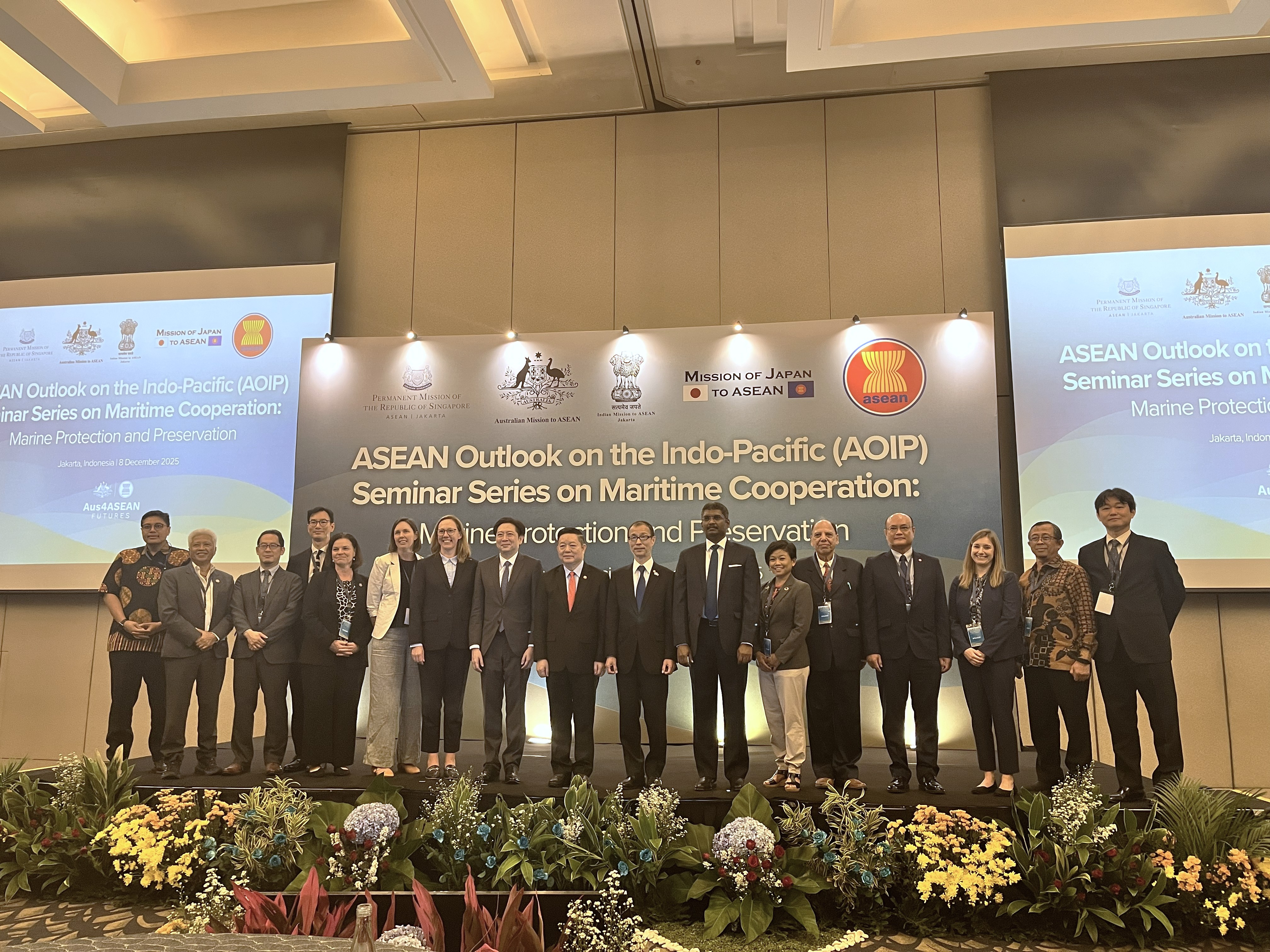
Jakarta, 8 December 2025: Under the theme of ‘Marine Protection and Preservation’, the third edition of the ASEAN Outlook on the Indo-Pacific (AOIP) Seminar Series on Maritime Cooperation was held to advance ASEAN’s efforts in safeguarding the Indo-Pacific marine environment. Co-hosted by Singapore, Australia, India, and Japan, and supported by the ASEAN Secretariat and the Australia for ASEAN Futures Initiative (Aus4ASEAN Futures), the seminar brought together regional leaders, experts, and institutions to review progress and chart strategic pathways for the future.
Discussions centred on ASEAN’s achievements and persisting gaps in marine protection, opportunities in the blue economy, the implications of the High Seas Biodiversity Treaty, and future pathways for co-operation to strengthen maritime sustainability. Building on this momentum, H.E. Dr Kao Kim Hourn, Secretary-General of ASEAN, underscored that marine protection and preservation remain critical to regional resilience. He also encouraged the ratification of key agreements and deeper commitments to safeguarding marine biodiversity.
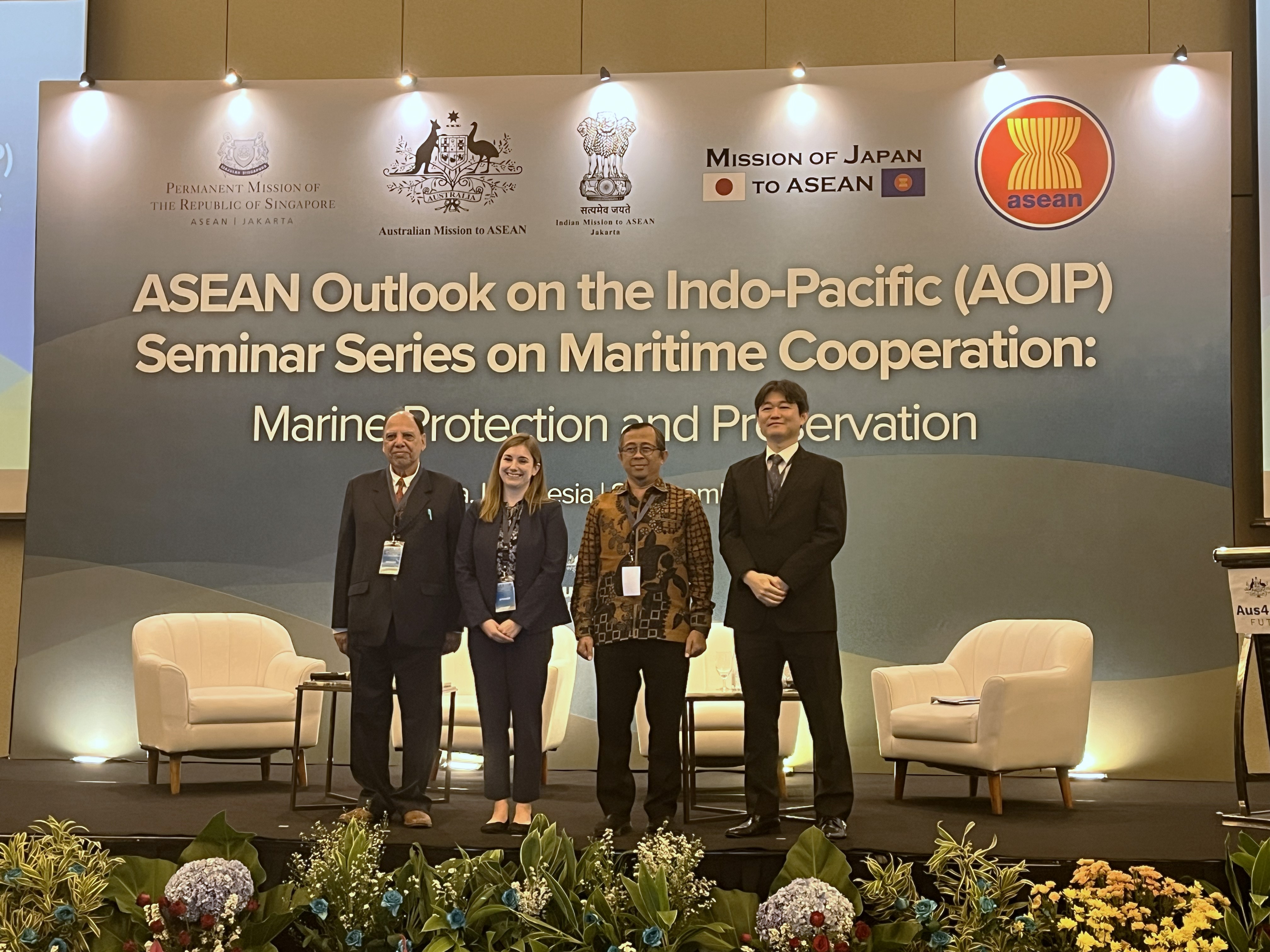
A key session focused on unlocking the potential of ASEAN’s blue economy. Moderated by Mr Reo Kawamura, Director of the Regional Knowledge Centre for Marine Plastic Debris (RKC-MPD), the ‘Opportunities in the Blue Economy’ session brought together experts who offered insights on how the region can enhance marine sustainability and align its blue economy ambitions with global commitments.
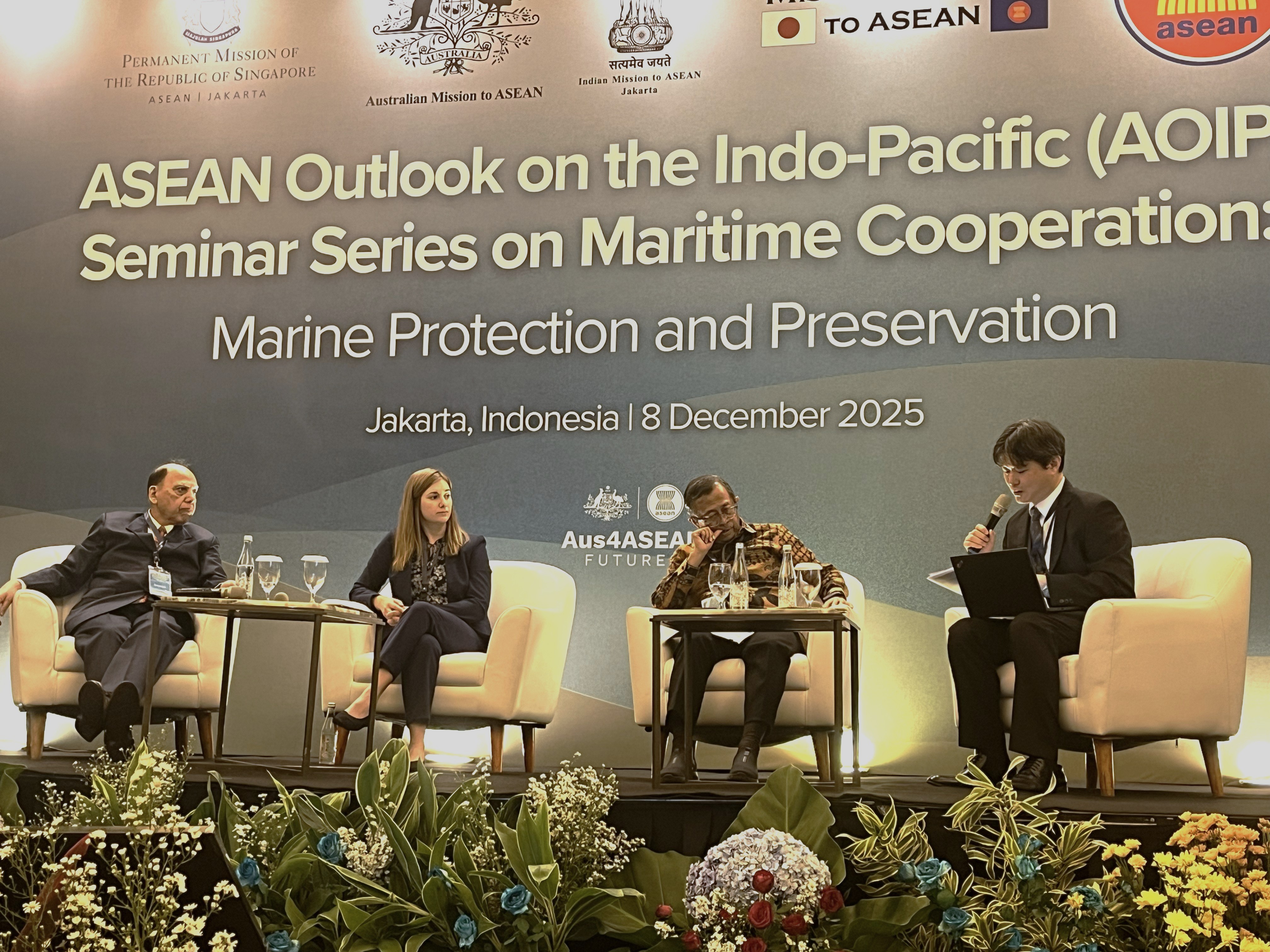
Mr Mohamad Rahmat Mulianda, Director of Marine Affairs and Fisheries at the Indonesian Ministry of National Development Planning, outlined Indonesia’s ongoing blue economy initiatives. These include strengthening the capacity of marine officers, expanding Other Effective Area-Based Conservation Measures (OECMs) to complement marine protected areas, and moving towards the ratification of the Biodiversity Beyond National Jurisdiction (BBNJ) agreement. These initiatives reflect Indonesia’s broader strategy to pursue blue economy growth while ensuring long-term marine ecosystem resilience.
Offering a regional academic perspective, Prof. Vishva Nath Attri, Director of the International Centre for Indo-Pacific Studies at Kurukshetra University, highlighted the diverse ways countries interpret the blue economy. Stressing the importance of Sustainable Development Goal (SDG) 14: Life Below Water, he observed that ‘The future of human prosperity lies in the ocean.’ He emphasised that the blue economy should be people-oriented, with particular attention to coastal communities.
Bringing in a governance lens, Dr Taryn Laubenstein, Ocean Policy Officer at the U.S. Department of State, discussed policy tools to simplify licensing processes, strengthen enforcement, and reduce administrative burdens that often hinder marine management. She underscored a critical gap – despite its global importance, SDG 14 remains the least funded SDG. Dr Laubenstein also called for stronger action against illegal, unreported, and unregulated (IUU) fishing; improved traceability systems enhanced by technologies such as AI; and deeper co-operation on seabed mineral surveying and environmental monitoring.
Mr Reo Kawamura, who delivered the final presentation during the session, highlighted ASEAN Member States’ shared commitment and the availability of various knowledge platforms to support blue economy development. However, while technical expertise exists, it has yet to be fully mainstreamed across the region, hence the need for a cohesive global framework to guide regional action.
Each panellist emphasised that the blue economy rests on four interconnected pillars –economic, ecological, social, and governance – which must work in harmony as one integrated system. The panellists called for more inclusive marine spatial planning, improved data collection, and broader stakeholder participation, especially from local communities and youth groups. Although ASEAN is making progress, this is not yet fully reflected in regional data, underscoring the critical role of science in guiding blue economy initiatives.

Research Associate


Jakarta, 8 December 2025: Under the theme of ‘Marine Protection and Preservation’, the third edition of the ASEAN Outlook on the Indo-Pacific (AOIP) Seminar Series on Maritime Cooperation was held to advance ASEAN’s efforts in safeguarding the Indo-Pacific marine environment. Co-hosted by Singapore, Australia, India, and Japan, and supported by the ASEAN Secretariat and the Australia for ASEAN Futures Initiative (Aus4ASEAN Futures), the seminar brought together regional leaders, experts, and institutions to review progress and chart strategic pathways for the future.
Discussions centred on ASEAN’s achievements and persisting gaps in marine protection, opportunities in the blue economy, the implications of the High Seas Biodiversity Treaty, and future pathways for co-operation to strengthen maritime sustainability. Building on this momentum, H.E. Dr Kao Kim Hourn, Secretary-General of ASEAN, underscored that marine protection and preservation remain critical to regional resilience. He also encouraged the ratification of key agreements and deeper commitments to safeguarding marine biodiversity.
A key session focused on unlocking the potential of ASEAN’s blue economy. Moderated by Mr Reo Kawamura, Director of the Regional Knowledge Centre for Marine Plastic Debris (RKC-MPD), the ‘Opportunities in the Blue Economy’ session brought together experts who offered insights on how the region can enhance marine sustainability and align its blue economy ambitions with global commitments.
Mr Mohamad Rahmat Mulianda, Director of Marine Affairs and Fisheries at the Indonesian Ministry of National Development Planning, outlined Indonesia’s ongoing blue economy initiatives. These include strengthening the capacity of marine officers, expanding Other Effective Area-Based Conservation Measures (OECMs) to complement marine protected areas, and moving towards the ratification of the Biodiversity Beyond National Jurisdiction (BBNJ) agreement. These initiatives reflect Indonesia’s broader strategy to pursue blue economy growth while ensuring long-term marine ecosystem resilience.
Offering a regional academic perspective, Prof. Vishva Nath Attri, Director of the International Centre for Indo-Pacific Studies at Kurukshetra University, highlighted the diverse ways countries interpret the blue economy. Stressing the importance of Sustainable Development Goal (SDG) 14: Life Below Water, he observed that ‘The future of human prosperity lies in the ocean.’ He emphasised that the blue economy should be people-oriented, with particular attention to coastal communities.
Bringing in a governance lens, Dr Taryn Laubenstein, Ocean Policy Officer at the U.S. Department of State, discussed policy tools to simplify licensing processes, strengthen enforcement, and reduce administrative burdens that often hinder marine management. She underscored a critical gap – despite its global importance, SDG 14 remains the least funded SDG. Dr Laubenstein also called for stronger action against illegal, unreported, and unregulated (IUU) fishing; improved traceability systems enhanced by technologies such as AI; and deeper co-operation on seabed mineral surveying and environmental monitoring.
Mr Reo Kawamura, who delivered the final presentation during the session, highlighted ASEAN Member States’ shared commitment and the availability of various knowledge platforms to support blue economy development. However, while technical expertise exists, it has yet to be fully mainstreamed across the region, hence the need for a cohesive global framework to guide regional action.
Each panellist emphasised that the blue economy rests on four interconnected pillars –economic, ecological, social, and governance – which must work in harmony as one integrated system. The panellists called for more inclusive marine spatial planning, improved data collection, and broader stakeholder participation, especially from local communities and youth groups. Although ASEAN is making progress, this is not yet fully reflected in regional data, underscoring the critical role of science in guiding blue economy initiatives.
Research Associate