



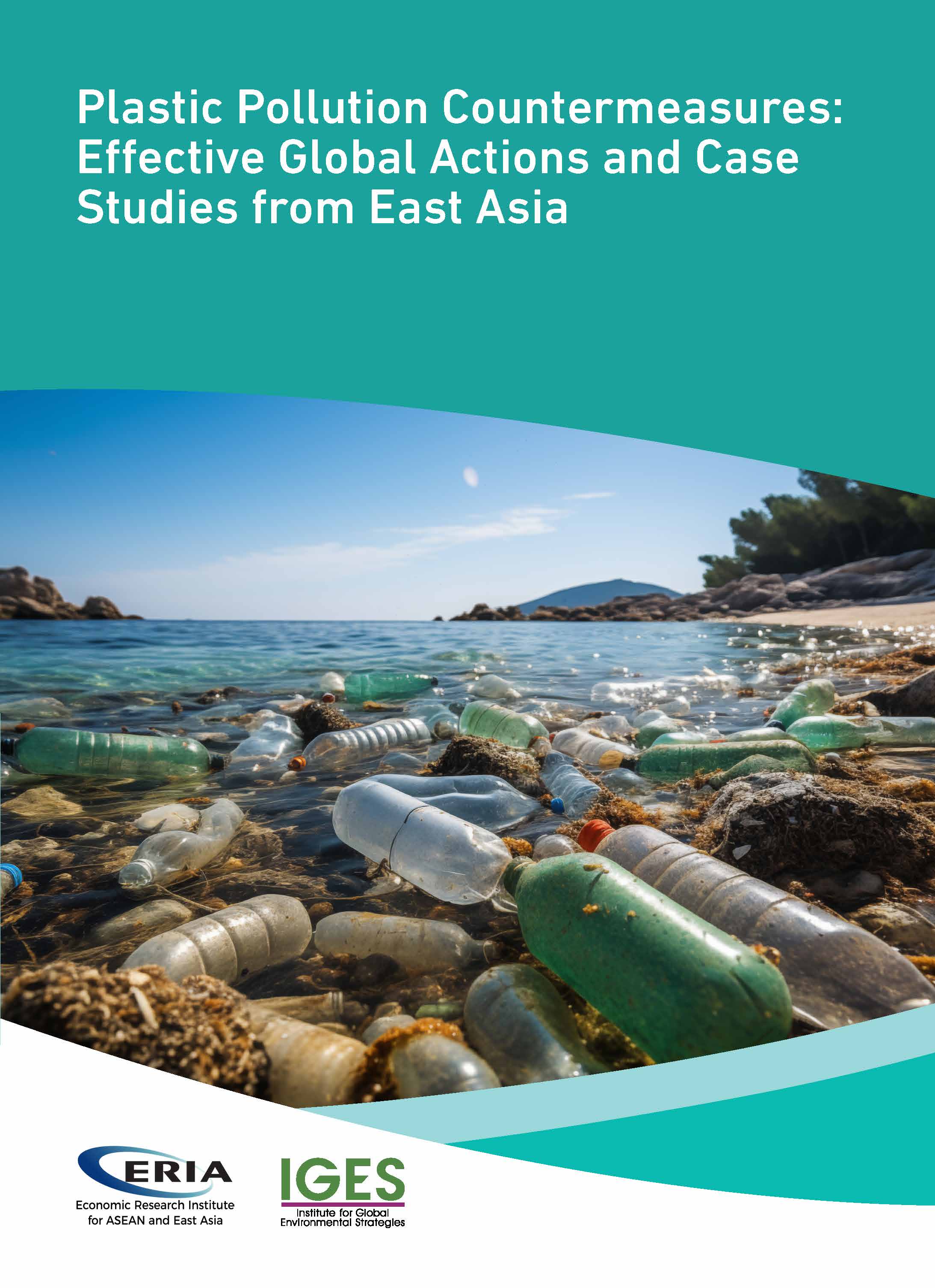
Plastic pollution has emerged as a critical global challenge, with the ASEAN+3 region identified as a major hotspot due to high emission levels and persistent gaps in waste management systems. This handbook offers a comprehensive, evidence-based overview for policymakers, practitioners, and researchers, presented in two main parts.
Part I provides a cross-national assessment of plastic pollution and its broader implications. It highlights that investing in sound waste management systems is significantly more cost-effective than post-pollution remediation. The section also outlines the environmental and human health impacts of plastics, reviews full life-cycle countermeasures – including behavioural change, Extended Producer Responsibility (EPR), and leakage prevention – and summarises relevant regional initiatives and the ongoing INC negotiations toward a global plastics agreement.
Part II presents country case studies from Cambodia, Indonesia, Lao PDR, Malaysia, Myanmar, the Philippines, Singapore, Thailand, China, Japan, and the Republic of Korea. These chapters showcase diverse national contexts, policy responses, and practical approaches to reducing plastic pollution, offering valuable lessons for regional adaptation.
The handbook concludes that strengthened regional co-operation, targeted investment in waste management infrastructure, and data-driven policymaking are essential to effectively address plastic pollution in ASEAN+3.
This publication is a joint effort of experts from ASEAN+3 Member States, the Economic Research Institute for ASEAN and East Asia (ERIA), and the Institute for Global Environmental Strategies (IGES).


Plastic pollution has emerged as a critical global challenge, with the ASEAN+3 region identified as a major hotspot due to high emission levels and persistent gaps in waste management systems. This handbook offers a comprehensive, evidence-based overview for policymakers, practitioners, and researchers, presented in two main parts.
Part I provides a cross-national assessment of plastic pollution and its broader implications. It highlights that investing in sound waste management systems is significantly more cost-effective than post-pollution remediation. The section also outlines the environmental and human health impacts of plastics, reviews full life-cycle countermeasures – including behavioural change, Extended Producer Responsibility (EPR), and leakage prevention – and summarises relevant regional initiatives and the ongoing INC negotiations toward a global plastics agreement.
Part II presents country case studies from Cambodia, Indonesia, Lao PDR, Malaysia, Myanmar, the Philippines, Singapore, Thailand, China, Japan, and the Republic of Korea. These chapters showcase diverse national contexts, policy responses, and practical approaches to reducing plastic pollution, offering valuable lessons for regional adaptation.
The handbook concludes that strengthened regional co-operation, targeted investment in waste management infrastructure, and data-driven policymaking are essential to effectively address plastic pollution in ASEAN+3.
This publication is a joint effort of experts from ASEAN+3 Member States, the Economic Research Institute for ASEAN and East Asia (ERIA), and the Institute for Global Environmental Strategies (IGES).
Fusanori Iwasaki, Reo Kawamura, Michikazu Kojima, Premakumara Jagath Dickella Gamaralalage, Yasuhiko Hotta
ERIA, IGES