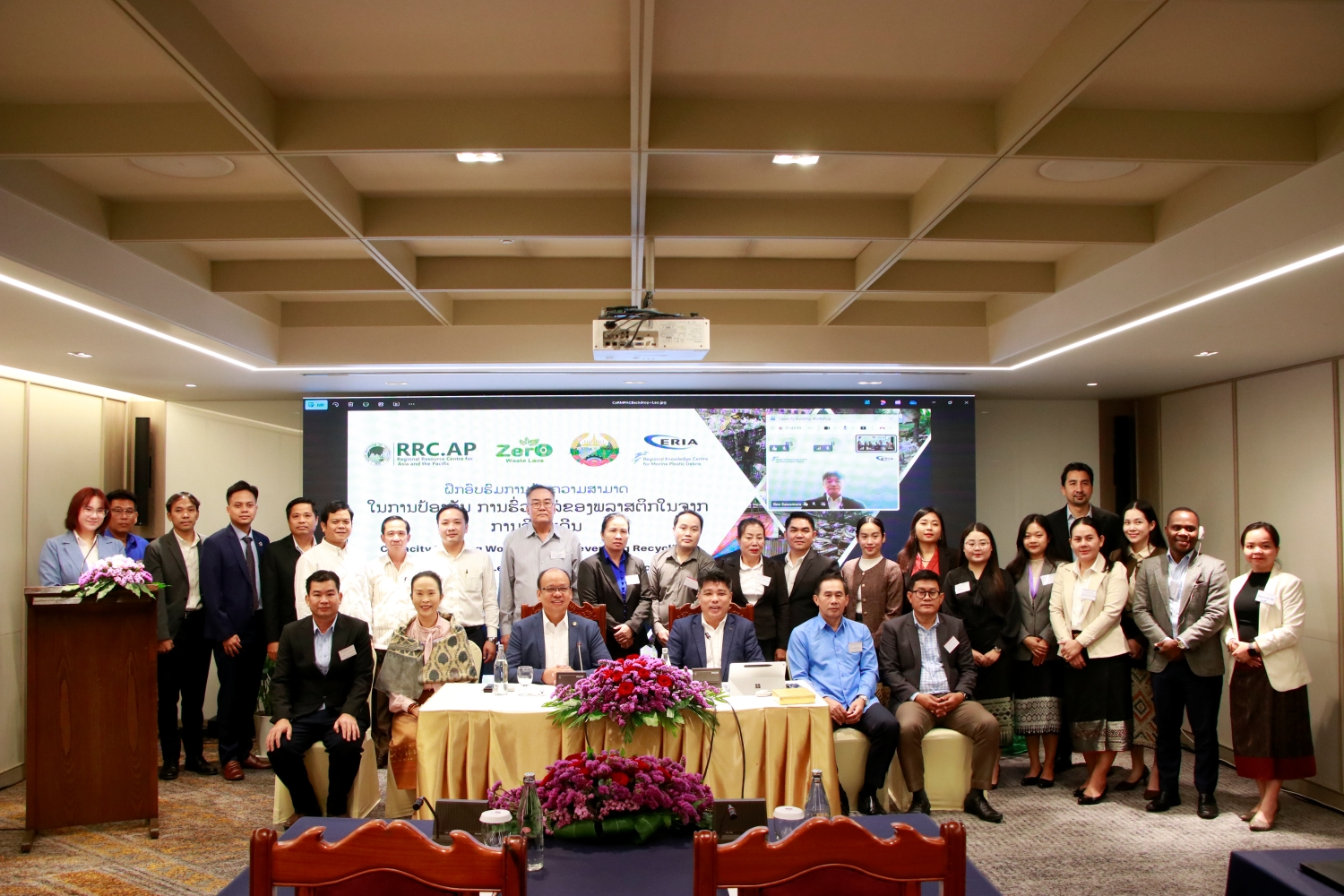




Vientiane, 18–19 May 2026: The Regional Knowledge Centre for Marine Plastic Debris at ERIA, in partnership with the Asian Institute of Technology’s Regional Resource Centre for Asia and Pacific (AIT RRC.AP), conducted a capacity-building workshop in Lao PDR.
It brought together government officials, private sector, academia, and other stakeholders working closely with the recycling sector to strengthen local capacity for identifying and preventing plastic leakage from recycling-related activities.
Vientiane is one of the 12 target cities under the CaRMPAC project. The city generates 771 tonnes of solid waste per day, yet 33% remains unmanaged. Open burning, illegal dumping, and waste littering waterways are still common. The city’s landfill is projected to reach capacity limit within 5–7 years, making the transition to a circular economy and improved recycling systems an operational necessity.
Recycling was identified as an overlooked yet quite significant pollution pathway. Informal and formal recycling operations, including junkshops and material recovery facilities (MRFs), play a vital role in waste management, but without adequate practices, policy support, and countermeasures, these operations can become unintended sources of plastic leakage.
Mr Alone Sayavong opened the workshop on behalf of the Government of Lao PDR. He welcomed participants and emphasised the national importance of the CaRMPAC project’s focus on preventing plastic leakage. He also expressed his gratitude to ERIA for providing financial support and to AIT for its technical input.
Dr Guilberto Borongan, Director of AIT RRC.AP, outlined the objectives and journey of the CaRMPAC project. After Phase 1 successfully engaged 27 recycling facilities and over 150 stakeholders across ASEAN cities, the current Phase 2 focuses on translating that knowledge into enhanced capacity at the city level.
Mr Reo Kawamura, Director of Environmental Policy and the Regional Knowledge Centre at ERIA, delivered his remarks by highlighting Vientiane’s strategic importance as the capital city, with its growing urbanisation, increasing plastic consumption, and expanding recycling sector. He underlined the opportunity to establish good practices before leakage pathways become entrenched. He also emphasised that the CaRMPAC project aligns with the Centre’s mandate to support ASEAN’s efforts to reduce marine plastic debris.
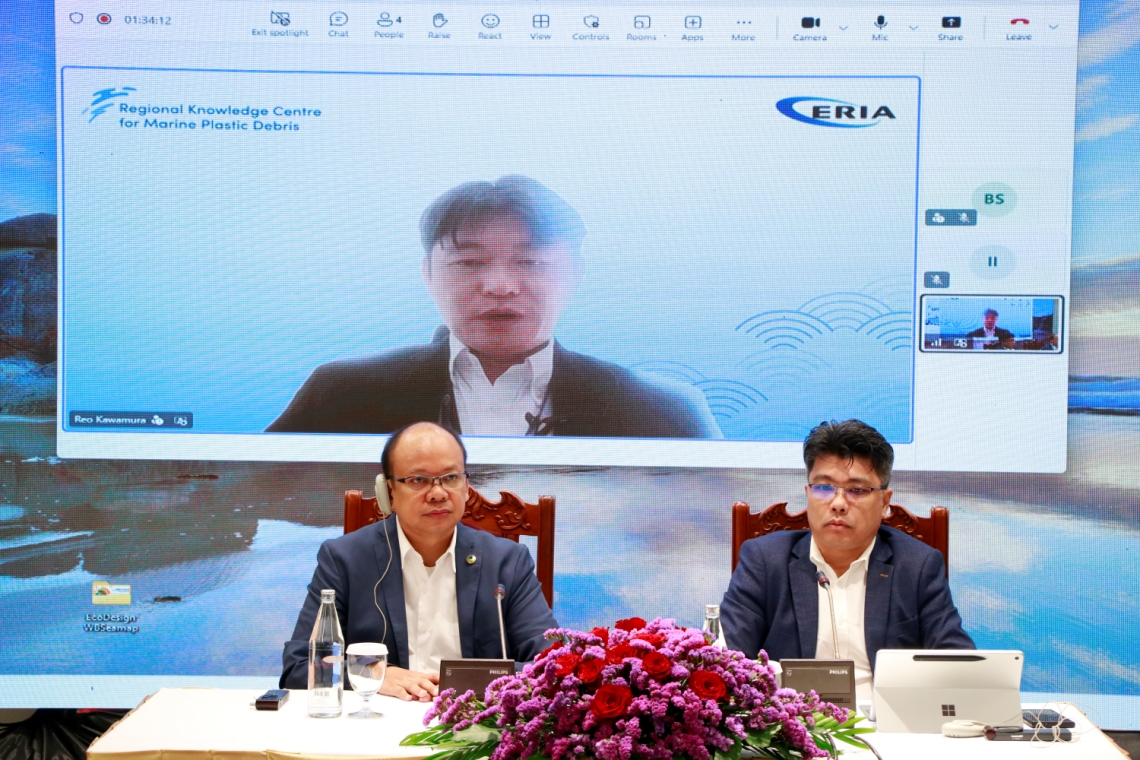
‘Preventing plastic leakage from recycling activities requires collaboration. Government agencies, recycling operators, informal workers, communities, researchers, and development partners all have a role to play. By working together, we can help ensure that recycling delivers its intended benefits: reducing waste, supporting livelihoods, and protecting the environment.’ – Mr Reo Kawamura
The first day established the policy and scientific foundation for meaningful capacity building. Participants received an overview of Lao PDR’ National Plastic Action Plan, which sets out four strategic objectives: 1) building a regulatory framework, 2) reducing environmental leakage, 3) developing resource recovery infrastructure, and 4) phasing out unnecessary single-use plastics.
The Vientiane Capital Office of Management and Services shared the city’s current waste management situation, including its transition toward waste-to-energy solutions and a new digital waste management platform.
Sessions then explored the science of plastic leakage, distinguishing between plastic loss, recoverable material within a facility, and plastic leakage – the latter of which was defined as the irreversible escape of plastic beyond a facility’s boundary into the environment. Leakage was mapped across the entire recycling chain, from consumers and waste collectors to consolidators and disposal facilities, with shredding and washing operations identified as the highest-risk stages.
On the second day, Mr Indradhi Faisal Ibrahim, Capacity Building Expert for the Regional Knowledge Centre, started the session on the health impacts of plastic pollution, linking the plastic leakage to its consequences for human health.
Drawing on the latest data, he situated the plastic pollution challenge within the broader context of the Triple Planetary Crises. Under a business-as-usual scenario, plastic leakage across Asia Pacific is projected to grow by 68% by 2050. In ASEAN alone, 29% of plastic waste was already mismanaged in 2022, increasing to 70% in lower-middle-income countries. The session also examined the pathways through which micro- and nanoplastics enter the human body through food, water, and air.
The discussion was followed by fundamental questions from a participant:
‘Can plastic simply be replaced? What would the material flow mapping or leakage pathways look like in Lao PDR?’ Mr Indradhi responded that the focus must be on eliminating harmful, unnecessary, and problematic plastics first, while building the monitoring infrastructure needed for evidence-based action.
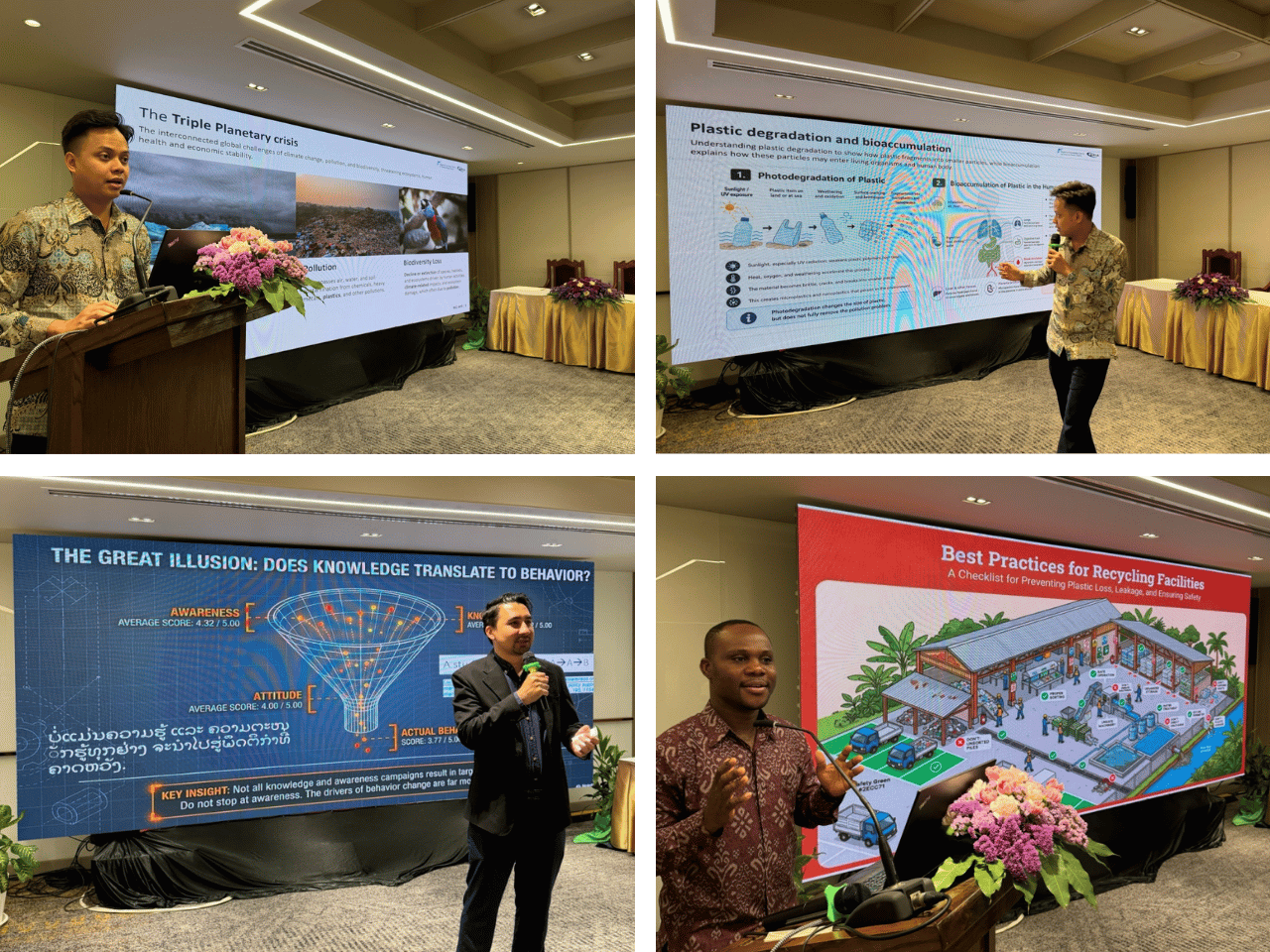
Mr Bishal Bhari of AIT RRC.AP led a session on behavioural change, introducing frameworks such as the Nudge Theory, Theory of Planned Behaviour, and Social Learning Theory to shift practices at the consumer, waste collector, and operator levels.
Mr Solomon Huno of AIT RRC.AP then shared the Anticipate, Prevent, Contain, Clean Up, and Remediate (APCCR) Model as a practical framework for recycling facilities to systematically reduce plastic losses and prevent plastic leakage. Best practices were mapped for each actor across the recycling chain, such as IEC campaigns for waste collectors; logical facility layouts and appropriate spacing for junkshops; and improved machinery configuration and covered storage for mechanical recyclers.
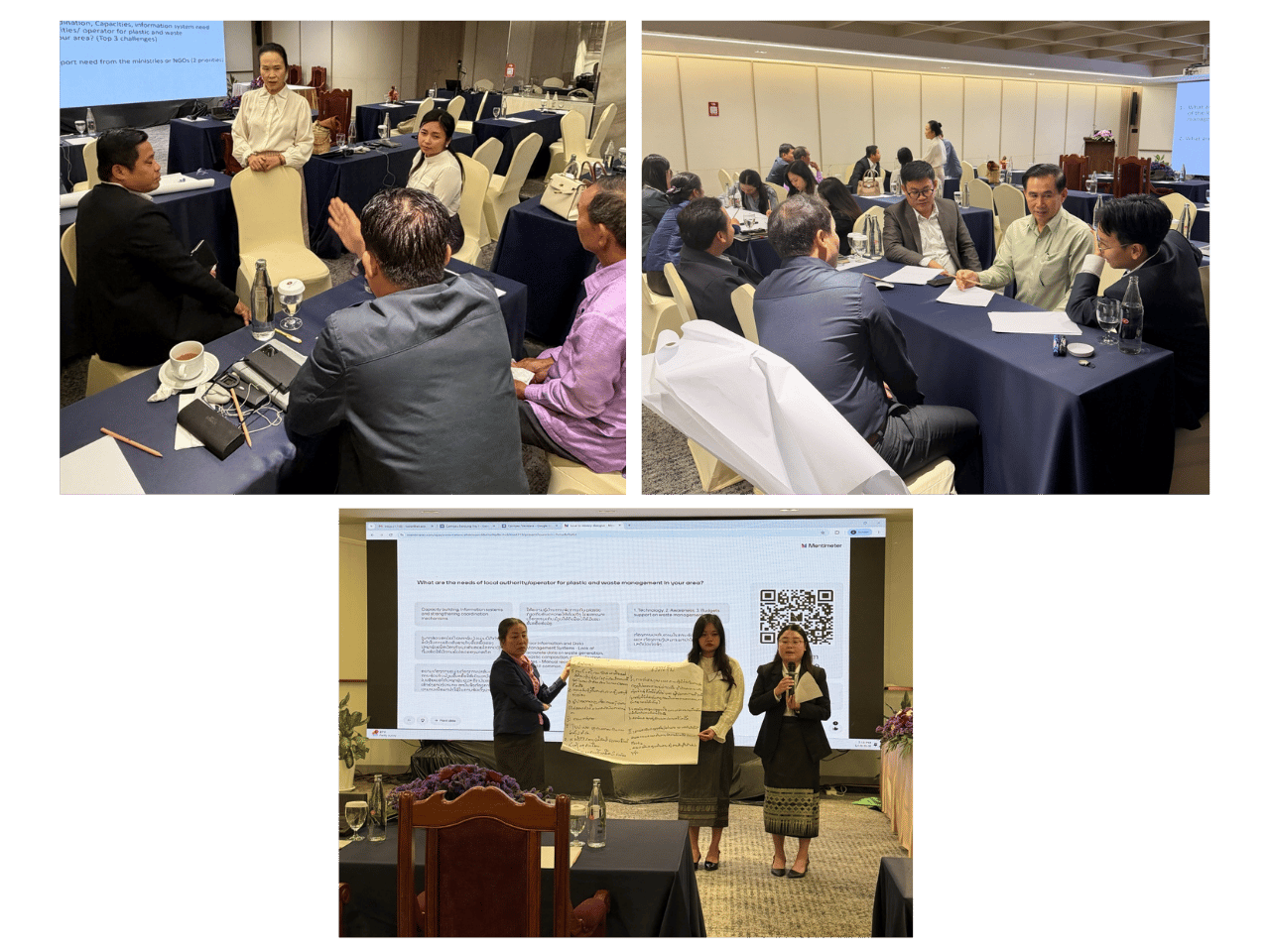
The Vientiane workshop demonstrated the potential of practical, localised, and cost-effective solutions. Participants engaged with both the science and practical realities of plastic leakage, and left with shared frameworks, such as the APCCR model. They also gained a clearer understanding of policy and behavioural levers needed to reduce leakage.
The workshop underscored a broader truth: addressing recycling-related plastic leakage in ASEAN requires sustained investment at the city and local levels. While national policies set the direction, it is the frontline practitioners – waste collectors, junkshop operators, MRF managers, and local government officials – who determine whether plastic stays in the loop or leaks into the environment.
Capacity Building Expert


Vientiane, 18–19 May 2026: The Regional Knowledge Centre for Marine Plastic Debris at ERIA, in partnership with the Asian Institute of Technology’s Regional Resource Centre for Asia and Pacific (AIT RRC.AP), conducted a capacity-building workshop in Lao PDR.
It brought together government officials, private sector, academia, and other stakeholders working closely with the recycling sector to strengthen local capacity for identifying and preventing plastic leakage from recycling-related activities.
Vientiane is one of the 12 target cities under the CaRMPAC project. The city generates 771 tonnes of solid waste per day, yet 33% remains unmanaged. Open burning, illegal dumping, and waste littering waterways are still common. The city’s landfill is projected to reach capacity limit within 5–7 years, making the transition to a circular economy and improved recycling systems an operational necessity.
Recycling was identified as an overlooked yet quite significant pollution pathway. Informal and formal recycling operations, including junkshops and material recovery facilities (MRFs), play a vital role in waste management, but without adequate practices, policy support, and countermeasures, these operations can become unintended sources of plastic leakage.
Mr Alone Sayavong opened the workshop on behalf of the Government of Lao PDR. He welcomed participants and emphasised the national importance of the CaRMPAC project’s focus on preventing plastic leakage. He also expressed his gratitude to ERIA for providing financial support and to AIT for its technical input.
Dr Guilberto Borongan, Director of AIT RRC.AP, outlined the objectives and journey of the CaRMPAC project. After Phase 1 successfully engaged 27 recycling facilities and over 150 stakeholders across ASEAN cities, the current Phase 2 focuses on translating that knowledge into enhanced capacity at the city level.
Mr Reo Kawamura, Director of Environmental Policy and the Regional Knowledge Centre at ERIA, delivered his remarks by highlighting Vientiane’s strategic importance as the capital city, with its growing urbanisation, increasing plastic consumption, and expanding recycling sector. He underlined the opportunity to establish good practices before leakage pathways become entrenched. He also emphasised that the CaRMPAC project aligns with the Centre’s mandate to support ASEAN’s efforts to reduce marine plastic debris.
‘Preventing plastic leakage from recycling activities requires collaboration. Government agencies, recycling operators, informal workers, communities, researchers, and development partners all have a role to play. By working together, we can help ensure that recycling delivers its intended benefits: reducing waste, supporting livelihoods, and protecting the environment.’ – Mr Reo Kawamura
The first day established the policy and scientific foundation for meaningful capacity building. Participants received an overview of Lao PDR’ National Plastic Action Plan, which sets out four strategic objectives: 1) building a regulatory framework, 2) reducing environmental leakage, 3) developing resource recovery infrastructure, and 4) phasing out unnecessary single-use plastics.
The Vientiane Capital Office of Management and Services shared the city’s current waste management situation, including its transition toward waste-to-energy solutions and a new digital waste management platform.
Sessions then explored the science of plastic leakage, distinguishing between plastic loss, recoverable material within a facility, and plastic leakage – the latter of which was defined as the irreversible escape of plastic beyond a facility’s boundary into the environment. Leakage was mapped across the entire recycling chain, from consumers and waste collectors to consolidators and disposal facilities, with shredding and washing operations identified as the highest-risk stages.
On the second day, Mr Indradhi Faisal Ibrahim, Capacity Building Expert for the Regional Knowledge Centre, started the session on the health impacts of plastic pollution, linking the plastic leakage to its consequences for human health.
Drawing on the latest data, he situated the plastic pollution challenge within the broader context of the Triple Planetary Crises. Under a business-as-usual scenario, plastic leakage across Asia Pacific is projected to grow by 68% by 2050. In ASEAN alone, 29% of plastic waste was already mismanaged in 2022, increasing to 70% in lower-middle-income countries. The session also examined the pathways through which micro- and nanoplastics enter the human body through food, water, and air.
The discussion was followed by fundamental questions from a participant:
‘Can plastic simply be replaced? What would the material flow mapping or leakage pathways look like in Lao PDR?’ Mr Indradhi responded that the focus must be on eliminating harmful, unnecessary, and problematic plastics first, while building the monitoring infrastructure needed for evidence-based action.
Mr Bishal Bhari of AIT RRC.AP led a session on behavioural change, introducing frameworks such as the Nudge Theory, Theory of Planned Behaviour, and Social Learning Theory to shift practices at the consumer, waste collector, and operator levels.
Mr Solomon Huno of AIT RRC.AP then shared the Anticipate, Prevent, Contain, Clean Up, and Remediate (APCCR) Model as a practical framework for recycling facilities to systematically reduce plastic losses and prevent plastic leakage. Best practices were mapped for each actor across the recycling chain, such as IEC campaigns for waste collectors; logical facility layouts and appropriate spacing for junkshops; and improved machinery configuration and covered storage for mechanical recyclers.
The Vientiane workshop demonstrated the potential of practical, localised, and cost-effective solutions. Participants engaged with both the science and practical realities of plastic leakage, and left with shared frameworks, such as the APCCR model. They also gained a clearer understanding of policy and behavioural levers needed to reduce leakage.
The workshop underscored a broader truth: addressing recycling-related plastic leakage in ASEAN requires sustained investment at the city and local levels. While national policies set the direction, it is the frontline practitioners – waste collectors, junkshop operators, MRF managers, and local government officials – who determine whether plastic stays in the loop or leaks into the environment.
Capacity Building Expert