




Jakarta, 10 June 2026: ERIA's Regional Knowledge Centre for Marine Plastic Debris contributed to a session on pollution during The Political Economy of Climate Change and the Energy Transition in Indonesia. Held in Jakarta on 8–10 June 2026, the event formed part of a field-visit workshop organised by Georgetown University, Stanford University, and Princeton University.
The workshop connected Indonesian researchers and policymakers with US- and Europe-based scholars to exchange ideas and stimulate new research on Indonesia's climate and energy transition challenges.
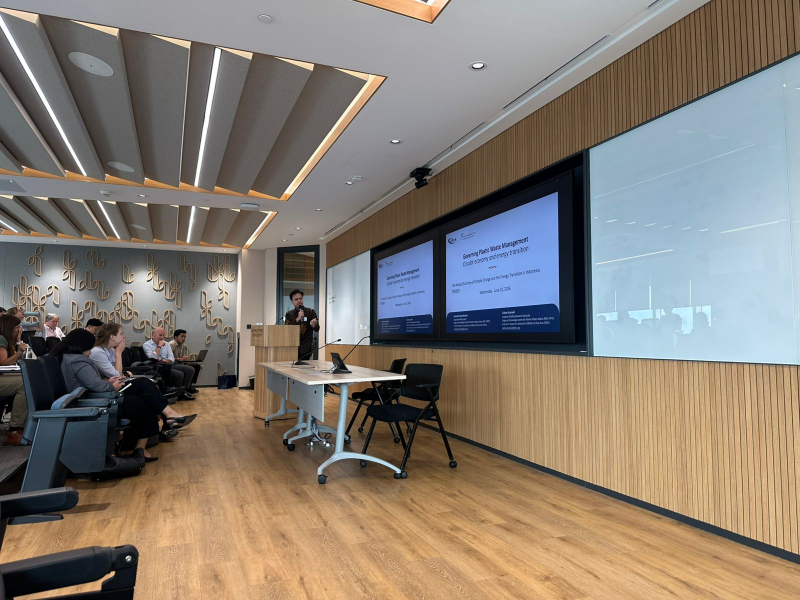
The session on pollution, held on the morning of 10 June and moderated by Assoc. Prof. Quynh Nguyen of the University of Bern, featured three presentations. Ms Batari Saraswati, Director at Systemiq, presented the economic case for co-ordinated action to improve Jakarta's air quality.
Dr Teguh Dartanto, Associate Professor of Economics at Universitas Indonesia, explored the links between economic transformation, PM2.5 air pollution, and the risk of non-communicable diseases in Indonesia.
Representing ERIA’s Regional Knowledge Centre was Mr Indradhi Faisal Ibrahim (Capacity Building Expert), who presented on governing plastic waste management in the context of the circular economy and the green energy transition in Southeast Asia, with a particular focus on Indonesia.
He highlighted the scale of mismanaged plastic waste across ASEAN, noting that 29% of regional plastic waste was mismanaged in 2022. He also traced Indonesia's evolving policy landscape, from Extended Producer Responsibility instruments to the renewed push for waste-to-energy development under Presidential Regulation No. 109/2025.
Mr Ibrahim further underscored the core governance challenge: balancing downstream energy recovery with upstream circular economy objectives, while ensuring that costs, benefits, and responsibilities are equitably distributed across all actors in the waste management system.
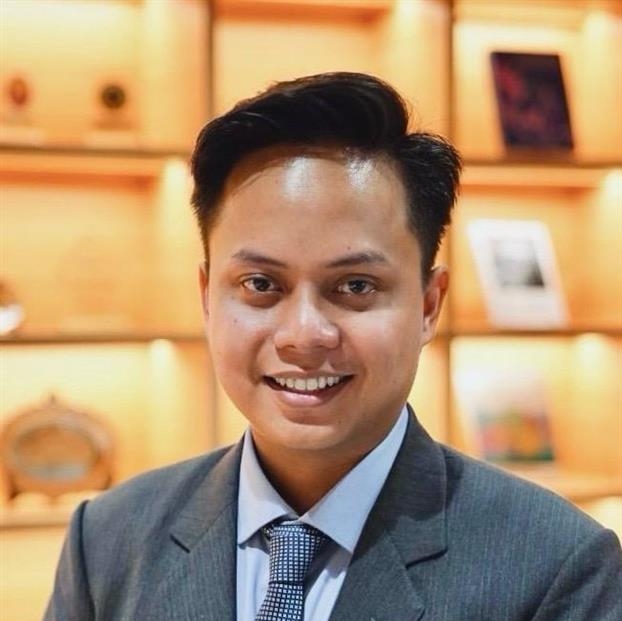
Capacity Building Expert


Jakarta, 10 June 2026: ERIA's Regional Knowledge Centre for Marine Plastic Debris contributed to a session on pollution during The Political Economy of Climate Change and the Energy Transition in Indonesia. Held in Jakarta on 8–10 June 2026, the event formed part of a field-visit workshop organised by Georgetown University, Stanford University, and Princeton University.
The workshop connected Indonesian researchers and policymakers with US- and Europe-based scholars to exchange ideas and stimulate new research on Indonesia's climate and energy transition challenges.
The session on pollution, held on the morning of 10 June and moderated by Assoc. Prof. Quynh Nguyen of the University of Bern, featured three presentations. Ms Batari Saraswati, Director at Systemiq, presented the economic case for co-ordinated action to improve Jakarta's air quality.
Dr Teguh Dartanto, Associate Professor of Economics at Universitas Indonesia, explored the links between economic transformation, PM2.5 air pollution, and the risk of non-communicable diseases in Indonesia.
Representing ERIA’s Regional Knowledge Centre was Mr Indradhi Faisal Ibrahim (Capacity Building Expert), who presented on governing plastic waste management in the context of the circular economy and the green energy transition in Southeast Asia, with a particular focus on Indonesia.
He highlighted the scale of mismanaged plastic waste across ASEAN, noting that 29% of regional plastic waste was mismanaged in 2022. He also traced Indonesia's evolving policy landscape, from Extended Producer Responsibility instruments to the renewed push for waste-to-energy development under Presidential Regulation No. 109/2025.
Mr Ibrahim further underscored the core governance challenge: balancing downstream energy recovery with upstream circular economy objectives, while ensuring that costs, benefits, and responsibilities are equitably distributed across all actors in the waste management system.
Capacity Building Expert



 Workshop Empowers Youth to Advance Environmental Action-6a1803513609b.png)