



Jakarta, 11 May 2026: ERIA’s Environment Unit participated in Session 1: Circular Economy (E-waste and Plastic Pollution) at the 2nd Indonesia-Japan Environment Week, hosted by the Ministry of the Environment, Japan (MOEJ) and Indonesia’s Ministry of Environment (KLH).
ERIA, along with the Overseas Environmental Cooperation Center, Japan (OECC), hosted the session. It welcomed 280 in-person and online participants, including academic experts and researchers, government officials, and circular economy-relevant business representatives from Indonesia and Japan.
Part 1 of this session focused on the challenges and opportunities of establishing environmentally sound e-waste management in Indonesia, and how Japan can support the transition to a circular economy across the ASEAN region.
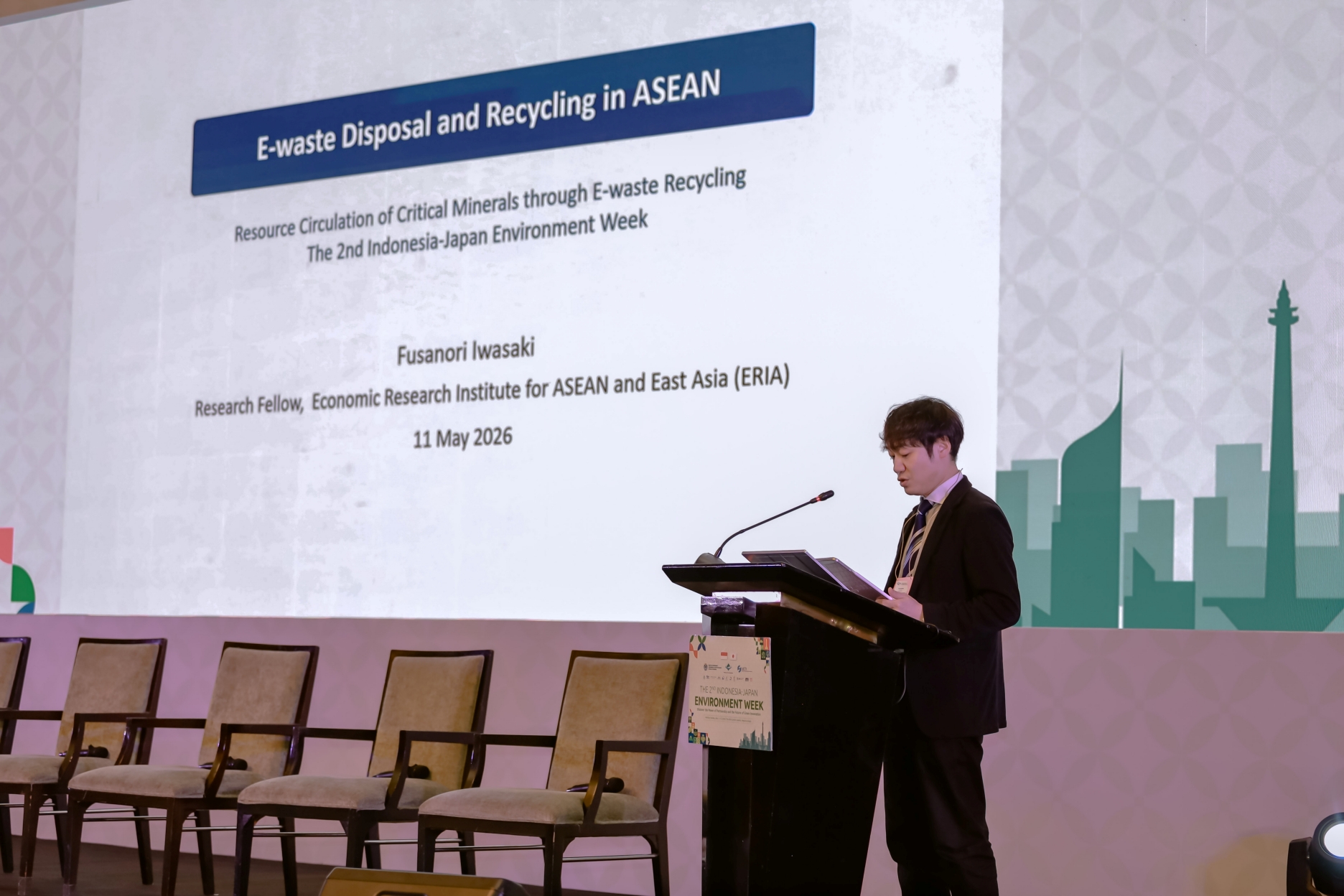
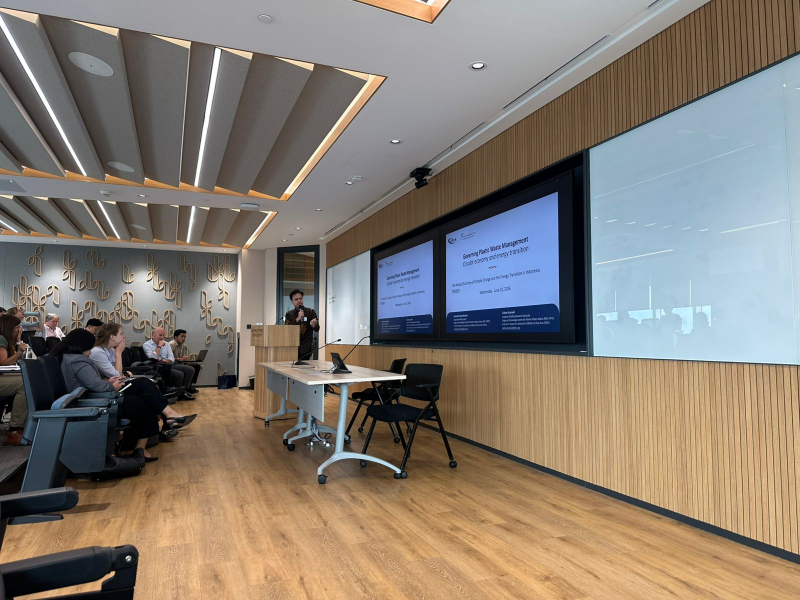
Mr Fusanori Iwasaki, Research Fellow at ERIA, presented findings from the institute research project, E-waste and Sound International Resource Circulation in ASEAN. All five ASEAN member states targeted in the project (Indonesia, Malaysia, the Philippines, Thailand, and Viet Nam) have established and implemented legal frameworks for e-waste management and disposal. However, they share common challenges, notably a rapid increase in e-waste generation alongside only partially developed systems for environmentally sound collection and treatment.
While legal frameworks exist in all five countries, formal collection rates remain low, treatment facilities are unevenly distributed, and implementation capacity is weak. In short, the problem is not the absence of a system, but its misalignment. Informal sectors dominate waste collection and dismantling across these nations. Consequently, it is necessary to integrate these informal sectors into the formal system through incentive-based measures, such as registration support, training, and co-operation with licensed facilities. This domestic situation also affects the transboundary movement of e-waste within this region.
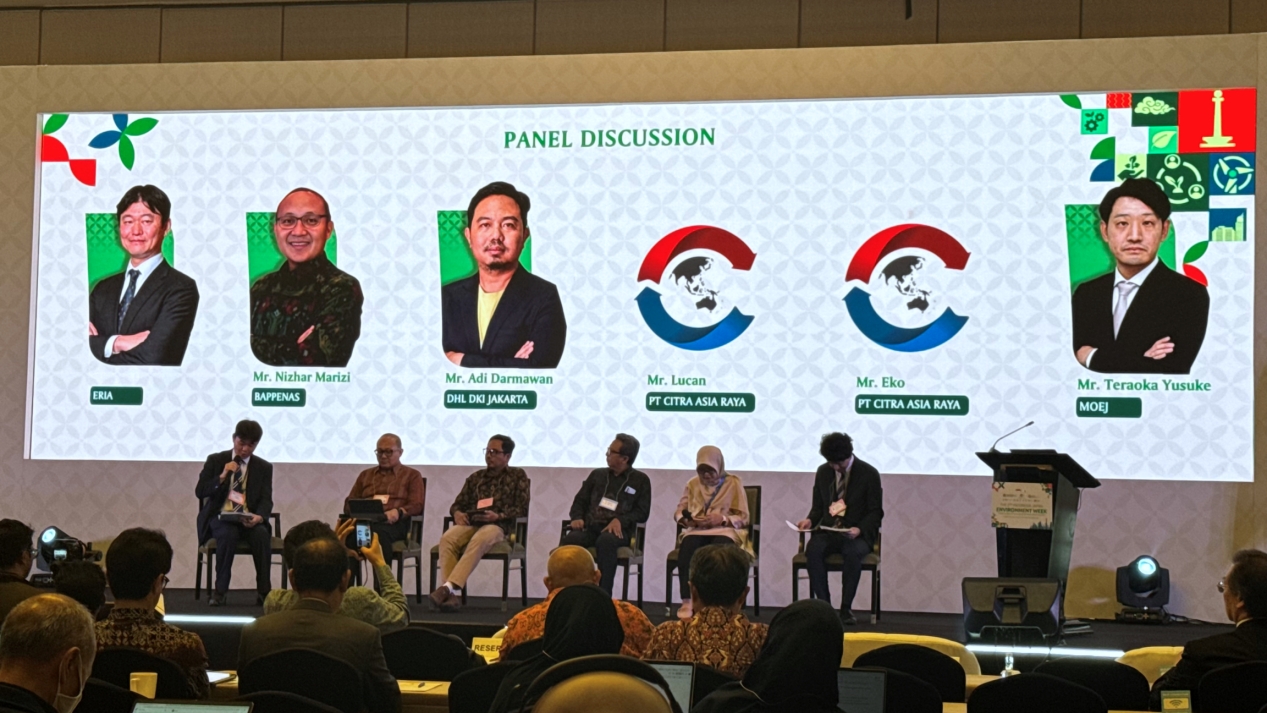
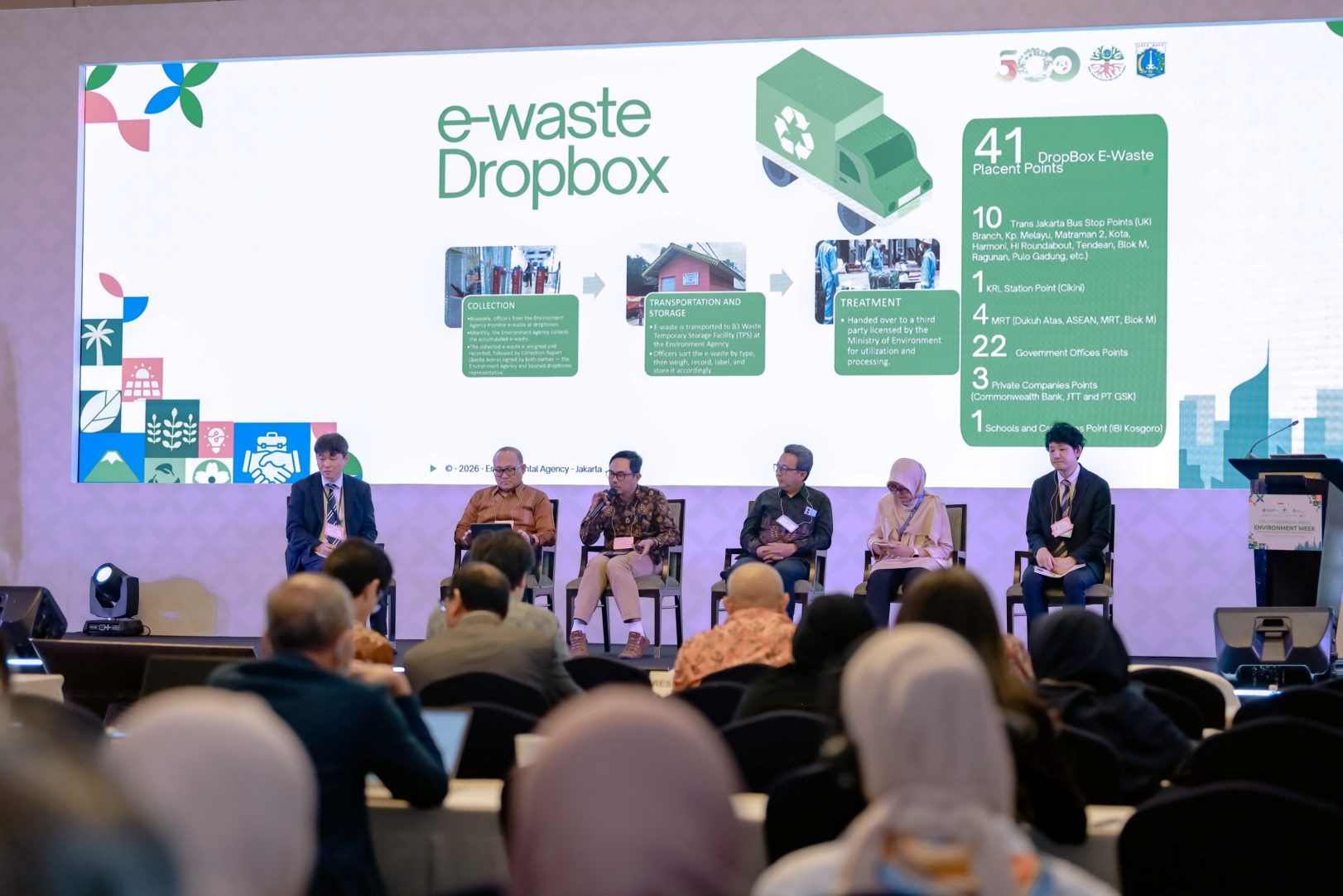
Mr Reo Kawamura, Director for Environmental Policy and Director for Regional Knowledge Centre for Marine Plastic Debris, moderated a panel discussion featuring experts from Indonesia’s Ministry of National Development Planning (BAPPENAS), Department of Environment of DKI Jakarta Province (DLH DKI Jakarta), PT Citra Asia Raya, and MOEJ. The Indonesian panellists showcased successful business practices in e-waste disposal and recycling, alongside a newly introduced national roadmap and Jakarta Province’s initiative to channel collected e-waste into the environmentally sound disposal and recycling routes.
The MOEJ representative referenced the ASEAN–Japan Resource Circulation Partnership on E-Waste, ELV, and Critical Minerals (ARCPEEC), reaffirming Japan’s readiness to support policymaking and capacity-building on e-waste issues in the ASEAN.
Part 2 of the session turned its focus to the challenges, opportunities, and available countermeasures of plastic pollution in Indonesia and the wider ASEAN region.
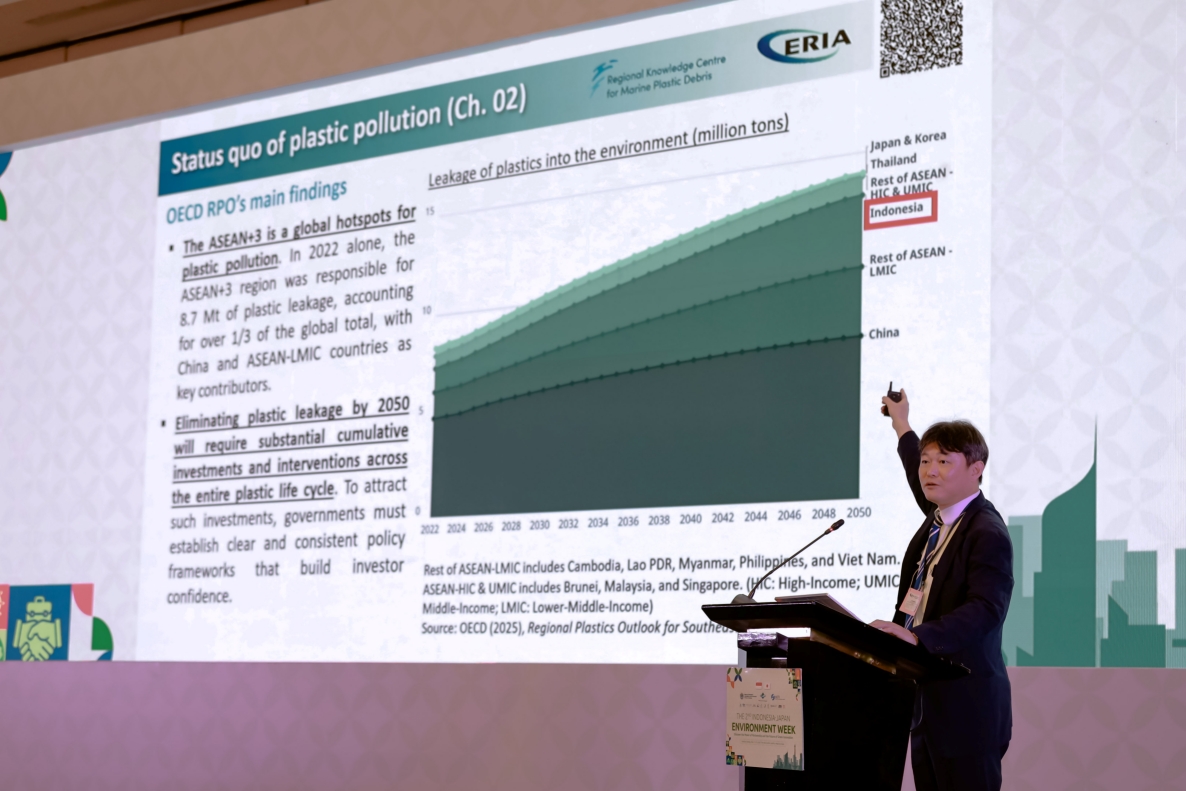
Mr Reo Kawamura introduced the ERIA’s forthcoming handbook titled Plastic Pollution Countermeasures: Effective Global Actions and Case Studies from East Asia, developed for academics and policymakers fighting against plastic pollution in ASEAN+3 countries. This book is divided into two parts: Part 1 addresses cross-country issues on plastic pollution, while Part 2 covers country-specific case studies on hot topics.
Regarding Indonesia, he highlighted that while the country is a major plastic pollution emitter in the region, it is leading the way in countermeasures. These include behaviour-change initiatives to control single-use plastics and the implementation of an Extended Producer Responsibility scheme.
Indonesian speakers from National Research and Innovation Agency and KLH delivered presentations to detailing the current situation, as well as ongoing and expected countermeasures to plastic pollution in Indonesia. This segment concluded with a business pitch from a representative of Indonesia-based PT. Prasadah Pamunah Limbah Industri (PPLi), owned by DOWA Eco-System CO., LTD., about its comprehensive waste management system.
The discussions underscored the importance of joint efforts between Indonesia and Japan to successfully achieve the transition to a circular economy.
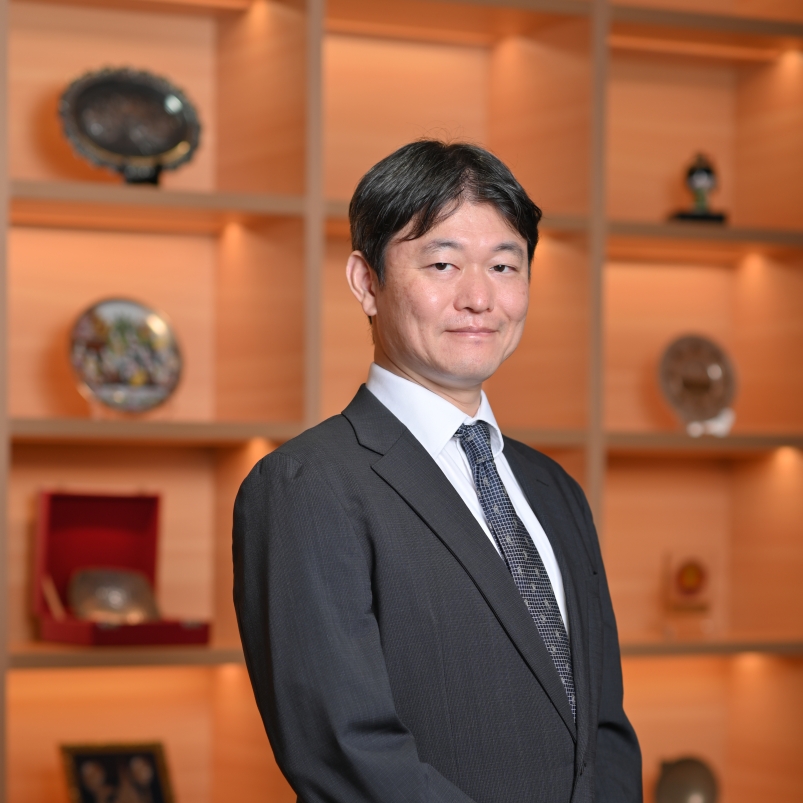
Director of the Knowledge Centre


Jakarta, 11 May 2026: ERIA’s Environment Unit participated in Session 1: Circular Economy (E-waste and Plastic Pollution) at the 2nd Indonesia-Japan Environment Week, hosted by the Ministry of the Environment, Japan (MOEJ) and Indonesia’s Ministry of Environment (KLH).
ERIA, along with the Overseas Environmental Cooperation Center, Japan (OECC), hosted the session. It welcomed 280 in-person and online participants, including academic experts and researchers, government officials, and circular economy-relevant business representatives from Indonesia and Japan.
Part 1 of this session focused on the challenges and opportunities of establishing environmentally sound e-waste management in Indonesia, and how Japan can support the transition to a circular economy across the ASEAN region.
Mr Fusanori Iwasaki, Research Fellow at ERIA, presented findings from the institute research project, E-waste and Sound International Resource Circulation in ASEAN. All five ASEAN member states targeted in the project (Indonesia, Malaysia, the Philippines, Thailand, and Viet Nam) have established and implemented legal frameworks for e-waste management and disposal. However, they share common challenges, notably a rapid increase in e-waste generation alongside only partially developed systems for environmentally sound collection and treatment.
While legal frameworks exist in all five countries, formal collection rates remain low, treatment facilities are unevenly distributed, and implementation capacity is weak. In short, the problem is not the absence of a system, but its misalignment. Informal sectors dominate waste collection and dismantling across these nations. Consequently, it is necessary to integrate these informal sectors into the formal system through incentive-based measures, such as registration support, training, and co-operation with licensed facilities. This domestic situation also affects the transboundary movement of e-waste within this region.
Mr Reo Kawamura, Director for Environmental Policy and Director for Regional Knowledge Centre for Marine Plastic Debris, moderated a panel discussion featuring experts from Indonesia’s Ministry of National Development Planning (BAPPENAS), Department of Environment of DKI Jakarta Province (DLH DKI Jakarta), PT Citra Asia Raya, and MOEJ. The Indonesian panellists showcased successful business practices in e-waste disposal and recycling, alongside a newly introduced national roadmap and Jakarta Province’s initiative to channel collected e-waste into the environmentally sound disposal and recycling routes.
The MOEJ representative referenced the ASEAN–Japan Resource Circulation Partnership on E-Waste, ELV, and Critical Minerals (ARCPEEC), reaffirming Japan’s readiness to support policymaking and capacity-building on e-waste issues in the ASEAN.
Part 2 of the session turned its focus to the challenges, opportunities, and available countermeasures of plastic pollution in Indonesia and the wider ASEAN region.
Mr Reo Kawamura introduced the ERIA’s forthcoming handbook titled Plastic Pollution Countermeasures: Effective Global Actions and Case Studies from East Asia, developed for academics and policymakers fighting against plastic pollution in ASEAN+3 countries. This book is divided into two parts: Part 1 addresses cross-country issues on plastic pollution, while Part 2 covers country-specific case studies on hot topics.
Regarding Indonesia, he highlighted that while the country is a major plastic pollution emitter in the region, it is leading the way in countermeasures. These include behaviour-change initiatives to control single-use plastics and the implementation of an Extended Producer Responsibility scheme.
Indonesian speakers from National Research and Innovation Agency and KLH delivered presentations to detailing the current situation, as well as ongoing and expected countermeasures to plastic pollution in Indonesia. This segment concluded with a business pitch from a representative of Indonesia-based PT. Prasadah Pamunah Limbah Industri (PPLi), owned by DOWA Eco-System CO., LTD., about its comprehensive waste management system.
The discussions underscored the importance of joint efforts between Indonesia and Japan to successfully achieve the transition to a circular economy.
Director of the Knowledge Centre