



Hai Phong, 21 April 2026: A stakeholder conference for the ASEAN-Norwegian Cooperation Project on Regional Capacity Building for Reducing Plastic Pollution – Phase 2 (ASEANO-2) was held on 21 April 2026 at the Vietnam Maritime University (VMU), supported by the Norwegian Institute for Water Research (NIVA) and the Center for Southeast Asian Studies (CSEAS).
The conference showcased regional and national priorities, progress achieved, and perspectives by key stakeholders such as the ASEAN Secretariat, ASEAN Working Group on Coastal Marine Environment, government agencies, and development partners.
In his opening remarks, Mr Erlend Skutlaberg, First Secretary at the Embassy of Norway in Viet Nam, expressed his appreciation for the opportunity to convene the conference and emphasised Norway’s strong commitment to ocean health and regional co-operation.
In a video message, H.E. San Lwin, Deputy Secretary-General of ASEAN for the ASEAN Socio-Cultural Community, highlighted the serious impacts of marine plastic pollution on biodiversity, fisheries, food security, and coastal livelihoods, and wished the conference success.
Assoc. Prof. Dr. Nguyen Minh Duc, Vice President of Vietnam Maritime University (VMU), underscored the need for collective action to address marine plastic pollution, noting that the conference provided a platform for stakeholders to collaborate on finding solutions.
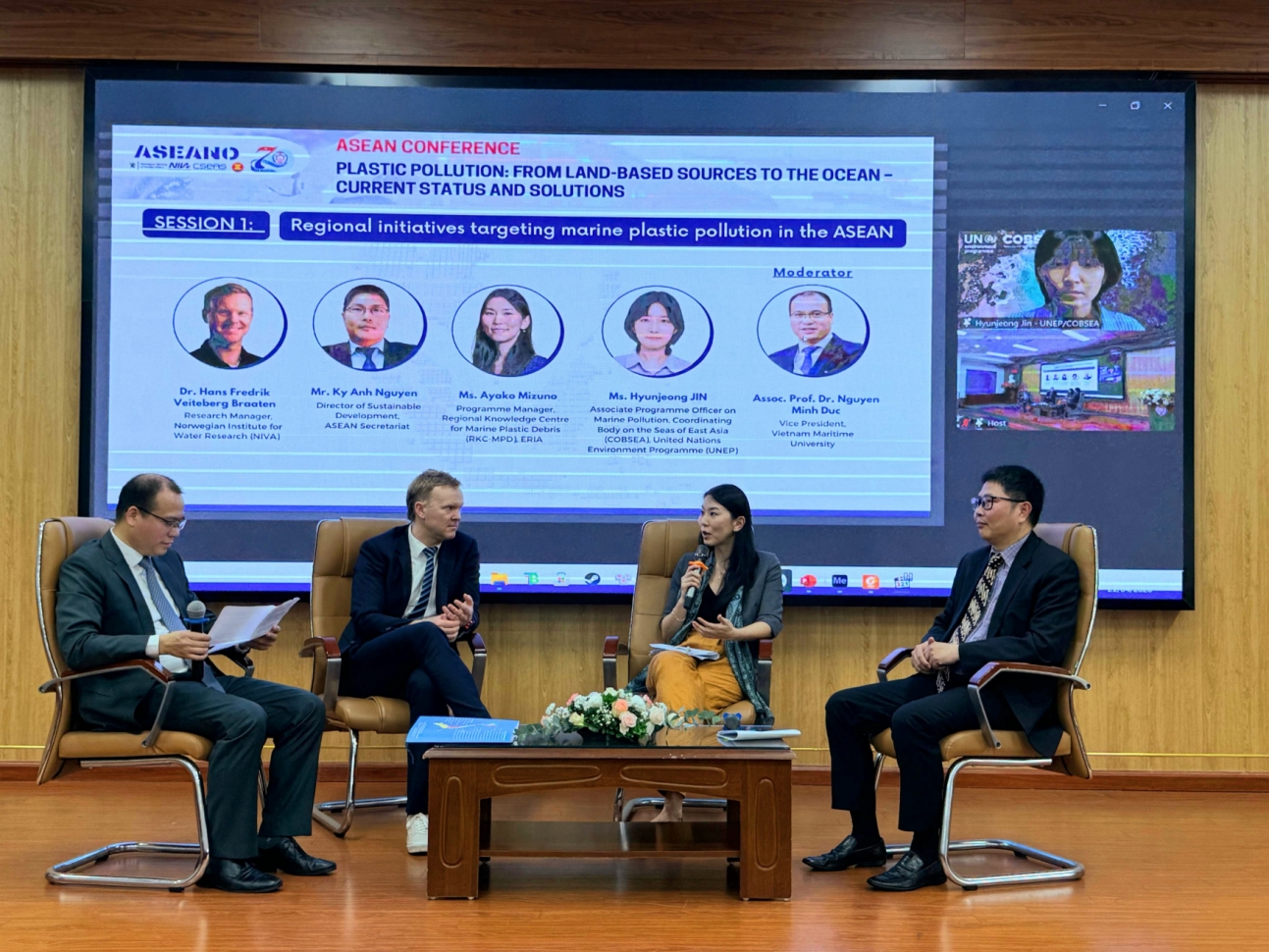
Session 1, themed ‘Regional Initiatives Targeting Marine Plastic Pollution in ASEAN,’ emphasised the importance of a coordinated regional approach:
Dr Hans Fredrik Veiteberg Braaten, Research Manager at NIVA, presented the catchment approach to establishing baselines for riverine plastic pollution and stressed the need for harmonised methodologies across ASEAN.
Mr Ky Anh Nguyen, Director of Sustainable Development at the ASEAN Secretariat, outlined ongoing co-operation under ASEAN frameworks, including the AWGCME Action Plan, implemented with partners such as NIVA, GIZ (3RproMar), the World Bank (SEA-MAP), and ERIA’s Regional Knowledge Centre for Marine Plastic Debris.
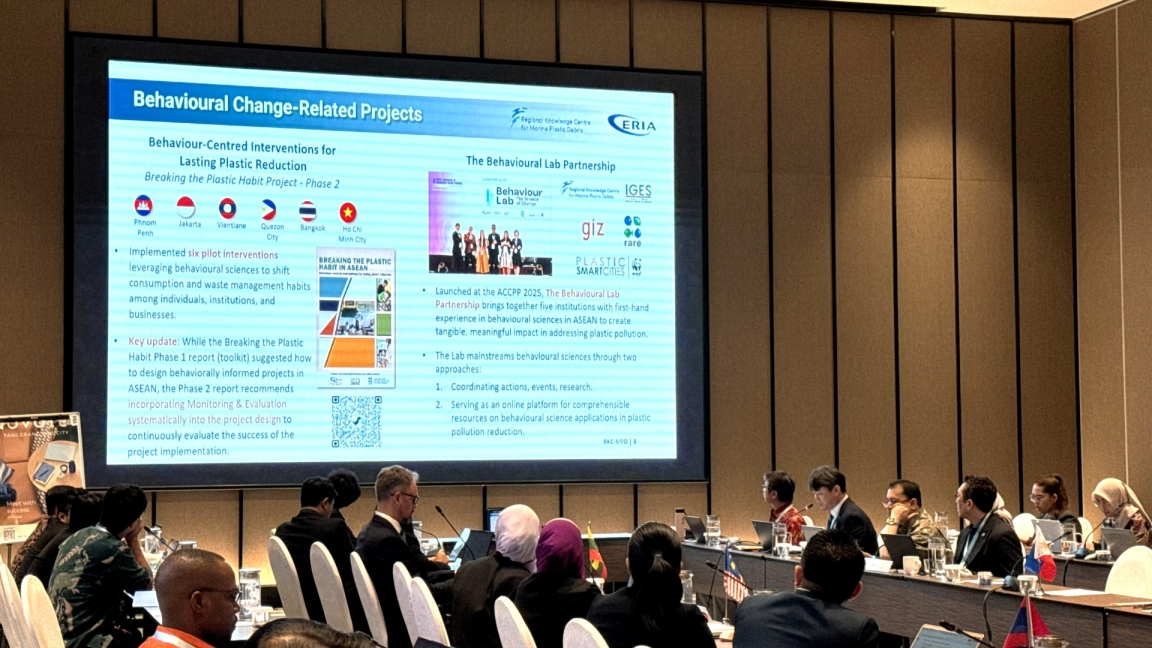
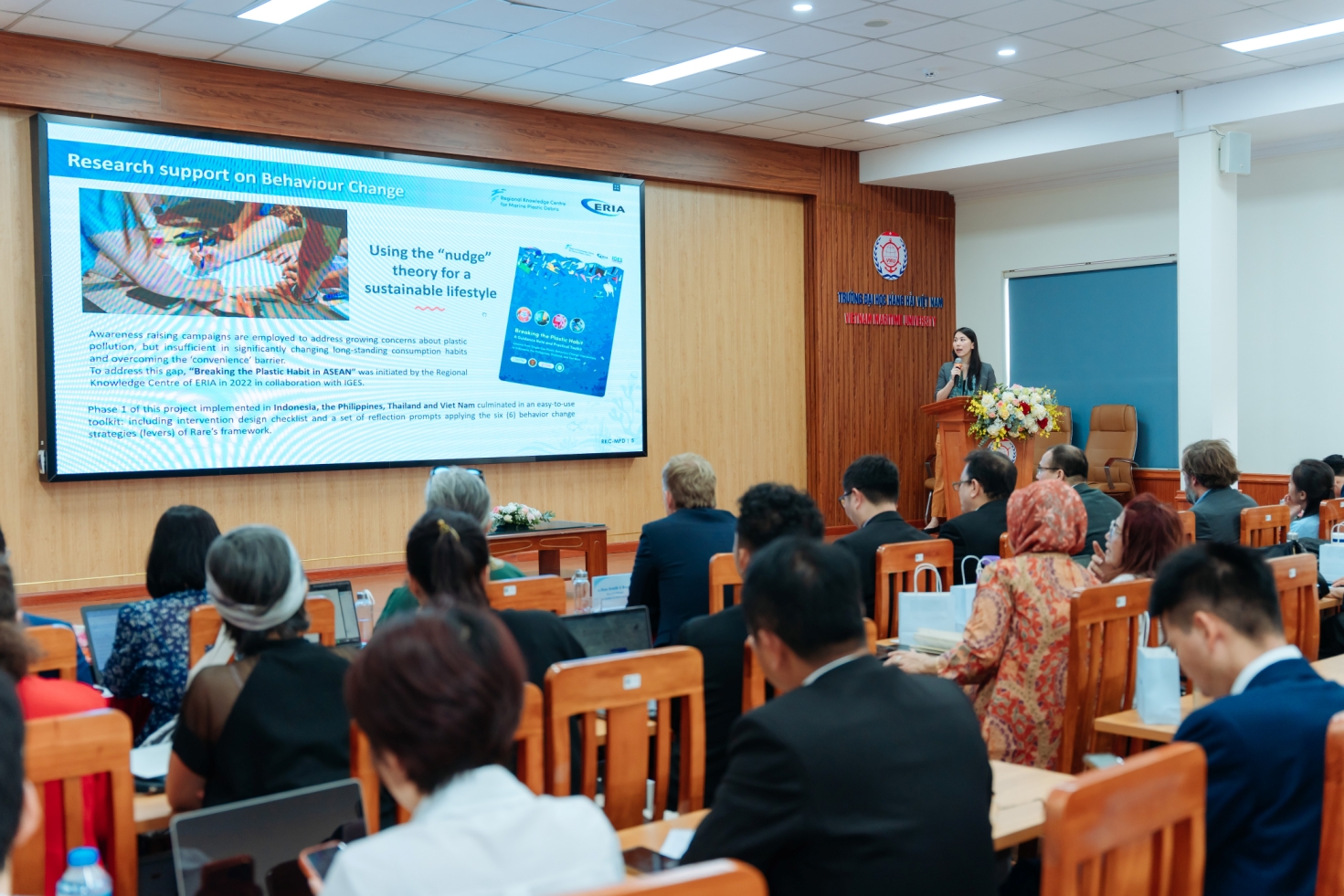
Ms Ayako Mizuno, Programme Manager at ERIA, explained the behavioural change projects implemented since 2022 by ERIA and IGES. She also introduced the newly established Behaviour Lab partnership, which brings together five regional partners to jointly tackle plastic pollution across ASEAN region employing behaviour change approaches. This initiative represents a concrete example of regional coordination on the ground.
Ms Hyunjeong Jin, Associate Programme Officer on Marine Pollution at COBSEA, UNEP, emphasised efforts to link ASEAN initiatives with global processes and strengthen regional co-operation.
Session 2 focused on national policies and initiatives, featuring government representatives from Viet Nam, Cambodia, Thailand, and the Philippines. Session 3 explored research gaps and drew on contributions from researchers and experts who are working on ASEANO-2 projects in Viet Nam and Cambodia, following earlier work in Indonesia and the Philippines under Phase 1 (ASEANO-1).
The conference brought together over 200 participants, both on-site and online, with active engagement during the Q&A sessions.
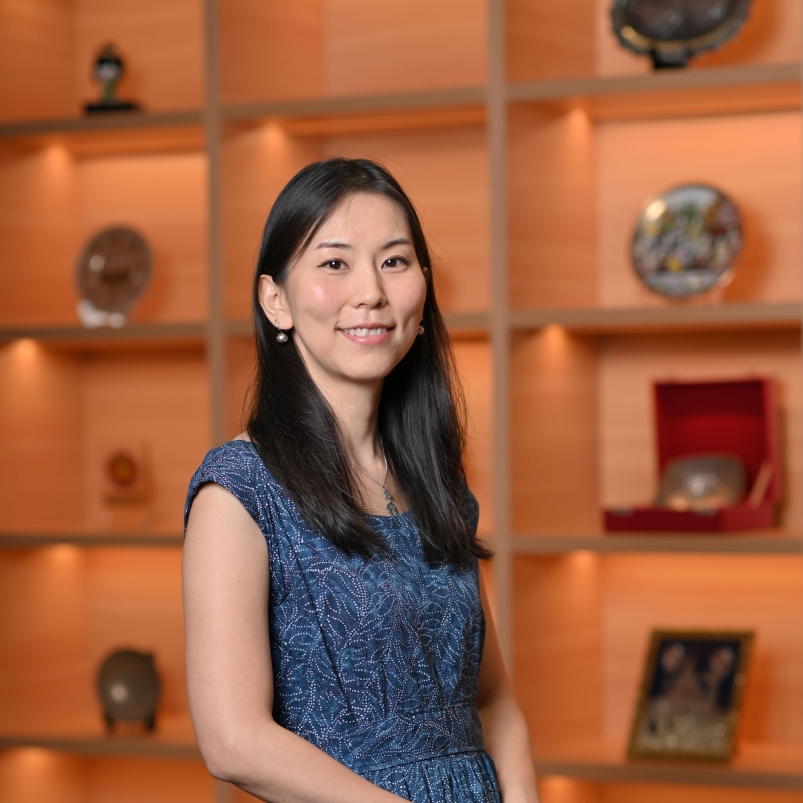
Programme Manager


Hai Phong, 21 April 2026: A stakeholder conference for the ASEAN-Norwegian Cooperation Project on Regional Capacity Building for Reducing Plastic Pollution – Phase 2 (ASEANO-2) was held on 21 April 2026 at the Vietnam Maritime University (VMU), supported by the Norwegian Institute for Water Research (NIVA) and the Center for Southeast Asian Studies (CSEAS).
The conference showcased regional and national priorities, progress achieved, and perspectives by key stakeholders such as the ASEAN Secretariat, ASEAN Working Group on Coastal Marine Environment, government agencies, and development partners.
In his opening remarks, Mr Erlend Skutlaberg, First Secretary at the Embassy of Norway in Viet Nam, expressed his appreciation for the opportunity to convene the conference and emphasised Norway’s strong commitment to ocean health and regional co-operation.
In a video message, H.E. San Lwin, Deputy Secretary-General of ASEAN for the ASEAN Socio-Cultural Community, highlighted the serious impacts of marine plastic pollution on biodiversity, fisheries, food security, and coastal livelihoods, and wished the conference success.
Assoc. Prof. Dr. Nguyen Minh Duc, Vice President of Vietnam Maritime University (VMU), underscored the need for collective action to address marine plastic pollution, noting that the conference provided a platform for stakeholders to collaborate on finding solutions.
Session 1, themed ‘Regional Initiatives Targeting Marine Plastic Pollution in ASEAN,’ emphasised the importance of a coordinated regional approach:
Dr Hans Fredrik Veiteberg Braaten, Research Manager at NIVA, presented the catchment approach to establishing baselines for riverine plastic pollution and stressed the need for harmonised methodologies across ASEAN.
Mr Ky Anh Nguyen, Director of Sustainable Development at the ASEAN Secretariat, outlined ongoing co-operation under ASEAN frameworks, including the AWGCME Action Plan, implemented with partners such as NIVA, GIZ (3RproMar), the World Bank (SEA-MAP), and ERIA’s Regional Knowledge Centre for Marine Plastic Debris.
Ms Ayako Mizuno, Programme Manager at ERIA, explained the behavioural change projects implemented since 2022 by ERIA and IGES. She also introduced the newly established Behaviour Lab partnership, which brings together five regional partners to jointly tackle plastic pollution across ASEAN region employing behaviour change approaches. This initiative represents a concrete example of regional coordination on the ground.
Ms Hyunjeong Jin, Associate Programme Officer on Marine Pollution at COBSEA, UNEP, emphasised efforts to link ASEAN initiatives with global processes and strengthen regional co-operation.
Session 2 focused on national policies and initiatives, featuring government representatives from Viet Nam, Cambodia, Thailand, and the Philippines. Session 3 explored research gaps and drew on contributions from researchers and experts who are working on ASEANO-2 projects in Viet Nam and Cambodia, following earlier work in Indonesia and the Philippines under Phase 1 (ASEANO-1).
The conference brought together over 200 participants, both on-site and online, with active engagement during the Q&A sessions.
Programme Manager

 Workshop Empowers Youth to Advance Environmental Action-6a1803513609b.png)